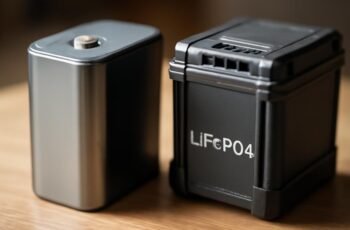
There’s a common assumption that all lithium-based batteries perform similarly, but the chemistry underlying LiFePO4 and lithium-ion cells reveals significant differences that challenge this view. While one offers higher energy density, the other provides superior safety and longevity. Understanding these nuances is vital for selecting the right technology for specific applications. To determine which battery type truly aligns with your needs, it’s essential to analyze their performance metrics and safety profiles in detail.
Key Takeaways
- LiFePO4 offers superior thermal stability and safety, reducing risks of fire and thermal runaway compared to lithium-ion batteries.
- Lithium-ion batteries have higher energy density, providing more storage capacity and lighter weight for compact applications.
- LiFePO4 provides longer cycle life, often exceeding 2,000 cycles, due to its stable chemistry and slower degradation.
- Lithium-ion batteries deliver higher power density, enabling faster charging and discharging for rapid power needs.
- LiFePO4 maintains consistent performance at high temperatures, making it ideal for demanding or extreme environments.
How Do LiFePO4 and Lithium-Ion Batteries Differ in Chemistry?
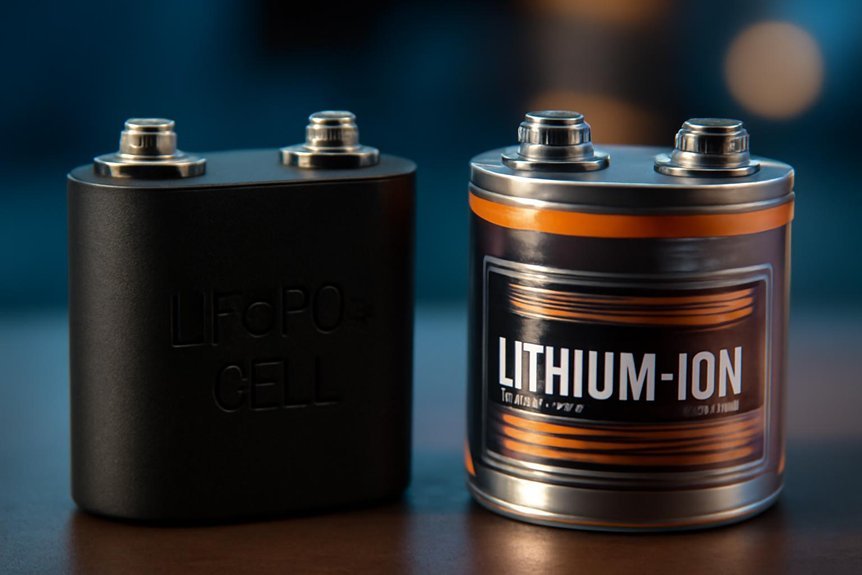
Batteries rely on specific chemical compositions to store and release energy effectively. In LiFePO4 and lithium-ion batteries, electrode materials dictate their electrochemical behavior and performance. LiFePO4 employs a lithium iron phosphate cathode, characterized by a stable crystal structure that facilitates ion mobility while resisting thermal degradation. Conversely, traditional lithium-ion batteries typically use layered metal oxides, such as lithium cobalt oxide, which allow higher energy density but can be less stable. The fundamental difference in chemistry influences ion mobility within the electrodes: LiFePO4’s olivine structure offers slower ion diffusion but greater safety, whereas layered cathodes enable faster ion transfer, enhancing power delivery. Understanding these chemical and structural distinctions helps explain their varied performance characteristics.
Which Battery Offers Better Safety and Stability?
When comparing safety and stability, thermal characteristics are essential, as they influence how batteries respond to temperature fluctuations. LiFePO4 batteries exhibit superior thermal stability, considerably reducing the risk of fire or thermal runaway. This stability makes them generally safer for high-demand or safety-critical applications.
Thermal Stability Differences
Although both LiFePO4 and traditional lithium-ion batteries are widely used in energy storage, LiFePO4 cells generally exhibit superior thermal stability, making them inherently safer under high-temperature conditions. Their improved heat management reduces risks associated with thermal degradation, especially during demanding applications. LiFePO4’s crystal structure resists decomposition at elevated temperatures, preventing rapid heat buildup. This stability translates into lower risks of thermal runaway and capacity loss. In contrast, lithium-ion batteries with cobalt or manganese cathodes are more susceptible to heat-induced degradation. Key points include:
- Enhanced resistance to thermal degradation
- Lower risk of overheating and thermal runaway
- Better heat dissipation properties
- Increased safety margins in high-temperature environments
These factors make LiFePO4 batteries more reliable for safety-critical uses.
Risk of Fire
Despite their widespread use, lithium iron phosphate (LiFePO4) batteries demonstrate a particularly lower risk of fire compared to traditional lithium-ion variants. This is primarily due to their inherent thermal stability and chemical composition, which reduce fire hazards considerably. LiFePO4’s stable cathode structure minimizes thermal runaway, a common trigger for battery fires. Consequently, safety protocols for LiFePO4 systems are generally less stringent, but proper fire prevention measures remain essential. In emergency response scenarios, LiFePO4 batteries pose less risk of violent failure, facilitating safer handling and disposal. While both battery types require vigilant fire protection strategies, LiFePO4’s improved stability offers enhanced safety margins, making it a more reliable choice where fire risk mitigation is critical.
How Do Performance Metrics Like Power and Efficiency Compare?
To accurately compare the performance metrics of Lifepo4 and lithium-ion batteries, we must examine their power output and efficiency under typical operating conditions. Lifepo4 batteries generally exhibit slightly lower power density than lithium-ion, but they maintain stable energy efficiency during high discharge rates. Lithium-ion batteries often deliver higher instantaneous power, making them suitable for rapid acceleration applications. However, Lifepo4’s consistent energy efficiency results in less energy loss over repeated cycles, contributing to overall system stability.
- Power density is essential for high-demand scenarios, favoring lithium-ion in some cases
- Energy efficiency impacts overall runtime and performance consistency
- Lifepo4 batteries excel in thermal stability, maintaining efficiency at higher temperatures
- Lithium-ion batteries typically achieve higher peak power outputs for short durations
What Are the Longevity and Maintenance Differences?
We observe that Lifepo4 batteries generally have a longer lifespan due to their more stable chemistry, often exceeding 2,000 charge cycles, compared to lithium-ion batteries. Maintenance needs also differ considerably; Lifepo4 requires less frequent monitoring and replacement due to reduced capacity fade. Understanding these variations is essential for evaluating long-term performance and operational costs.
Battery Lifespan Variations
Battery lifespan is a critical factor in evaluating lithium iron phosphate (LiFePO₄) and lithium-ion (Li-ion) technologies, as it directly impacts long-term performance and maintenance costs. Differences in cycle longevity influence how quickly each chemistry undergoes battery degradation over time. LiFePO₄ batteries typically exhibit higher cycle counts before significant capacity loss, resulting in slower degradation. In contrast, Li-ion batteries may experience faster capacity fade due to more pronounced degradation mechanisms. Factors affecting lifespan include:
- Degradation mechanisms linked to temperature and charge cycles
- Variations in anode and cathode stability
- Impact of depth of discharge on cycle longevity
- Electrolyte stability over extended use
Understanding these variations helps optimize battery selection for longevity and cost-effectiveness.
Maintenance Requirements Differences
While the cycle life of LiFePO₄ and Li-ion batteries influences their long-term performance, maintenance requirements further distinguish these chemistries regarding overall longevity management. LiFePO₄ batteries generally demand less frequent routine inspections, with a focus on checking terminal corrosion and guaranteeing secure connections, owing to their stable chemistry. They typically experience fewer electrolyte level concerns, reducing maintenance complexity. In contrast, Li-ion batteries may require more regular monitoring of electrolyte levels to prevent capacity loss and guarantee peak performance. Charging cycles are critical in both types; overcharging or deep discharging can accelerate degradation, but LiFePO₄ batteries exhibit greater resilience to these stresses. Overall, LiFePO₄’s lower maintenance needs make it more suitable for long-term applications with minimal upkeep.
Which Battery Type Is More Cost-Effective Over Time?
Determining which battery type offers greater cost-effectiveness over time requires analyzing initial investment, lifespan, and maintenance costs. A thorough cost analysis reveals that Lifepo4 batteries tend to provide better long-term savings due to their durability and lower maintenance needs. Lithium-ion batteries may have a lower upfront cost but often require more frequent replacements and higher upkeep. Key factors include:
- Higher initial purchase price for Lifepo4
- Longer cycle life of Lifepo4 (up to 10,000 cycles)
- Reduced maintenance costs with Lifepo4
- Greater resilience to deep discharges, extending lifespan
How Do Applications Influence the Choice Between LiFePO4 and Lithium-Ion?
How do different applications influence the choice between LiFePO4 and lithium-ion batteries? Application scenarios considerably shape this decision, as usage demands vary across industries. For example, energy requirements for electric vehicles emphasize high energy density, favoring lithium-ion batteries, whereas stationary energy storage or solar systems prioritize safety and long cycle life, aligning with LiFePO4’s strengths. Environmental considerations also play a role; LiFePO4 offers enhanced thermal stability and reduced toxicity, making it preferable in sensitive settings. Industry preferences depend on performance needs—rapid charging, longevity, or safety. Ultimately, understanding specific application scenarios helps determine whether the higher energy density of lithium-ion or the durability and safety profile of LiFePO4 best meet the demands of each use case.
Frequently Asked Questions
How Do Environmental Conditions Affect Lifepo4 and Lithium-Ion Battery Performance?
Environmental conditions greatly impact battery lifespan and performance metrics; high temperatures accelerate degradation, while cold reduces capacity. Lifepo4 batteries generally tolerate temperature fluctuations better, maintaining stability, whereas lithium-ion batteries are more sensitive, affecting overall reliability in diverse environments.
Are There Any Recycling or Disposal Differences Between These Battery Types?
Recycling processes and disposal regulations are more straightforward for Lifepo4 batteries, which pose less environmental risk and are easier to recycle. Lithium-ion batteries require meticulous handling due to hazardous materials, making their disposal more complex and regulated.
What Are the Charging Time Differences for Lifepo4 Versus Lithium-Ion Batteries?
We find Lifepo4 batteries typically charge faster with higher charging efficiency and maintain cycle longevity better over time, whereas lithium-ion batteries often take longer to reach full capacity, influenced by their different chemistries and thermal management needs.
How Do Temperature Extremes Impact Battery Safety and Efficiency?
Extreme temperatures threaten battery safety and efficiency, causing significant performance drops or safety risks. Lithium-ion batteries struggle with thermal instability, while Lifepo4’s superior thermal stability and safety mechanisms guarantee more reliable operation under temperature extremes, protecting users and devices.
Can These Batteries Be Safely Used in High-Vibration Environments?
We find these batteries generally offer good vibration resistance, enhancing their durability in high-vibration environments. Their robust design guarantees reliable performance, making them suitable for applications requiring consistent energy output despite continuous mechanical shocks or movement.
Conclusion
To summarize, choosing between LiFePO4 and lithium-ion batteries is like selecting the right tool for a specific job—we must weigh performance, safety, and longevity. LiFePO4 excels in stability and durability, making it ideal for long-term, safety-critical applications. Meanwhile, lithium-ion batteries offer superior power density for rapid, high-efficiency needs. Understanding these differences helps us make informed, data-driven decisions tailored to our unique energy demands.