While both LiFePO4 and AGM batteries serve essential roles in energy storage, their fundamental differences in technology and application are significant. Understanding these distinctions is vital for selecting the most suitable option for specific needs, whether for long-term reliability or initial cost savings. As we examine their construction, performance, and overall value, it becomes clear that choosing the right battery type requires careful consideration of several technical and practical factors.
Key Takeaways
- LiFePO4 batteries provide higher efficiency, longer cycle life, and better thermal stability than AGM lead-acid batteries.
- AGM batteries are more affordable initially but have shorter lifespans and lower cycle durability.
- LiFePO4 is safer, non-flammable, and ideal for deep cycling applications like marine and EV use.
- AGM batteries are suitable for emergency backup and portable power due to their sealed, maintenance-free design.
- Long-term cost savings favor LiFePO4 despite higher upfront investment.
How Do Lifepo4 and AGM Batteries Differ in Technology and Construction
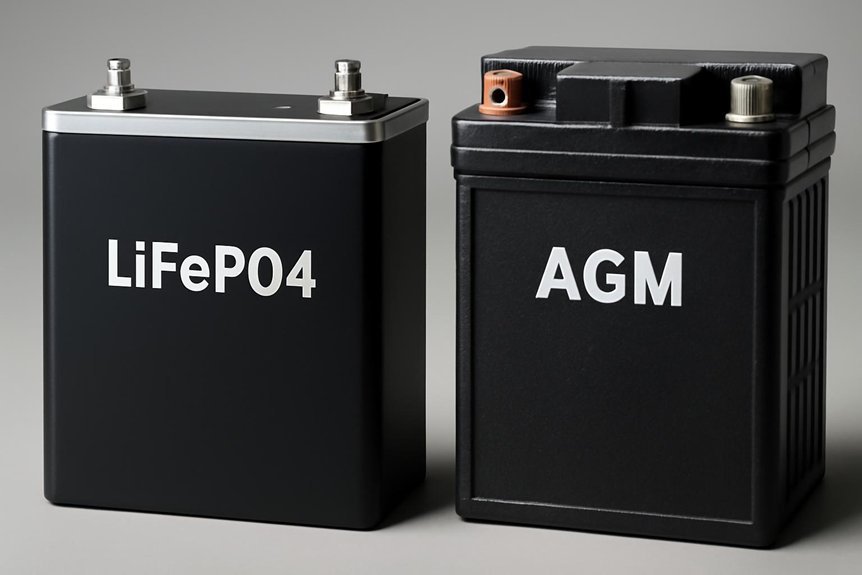
How do LiFePO4 and AGM batteries differ in their underlying technology and construction? The primary distinction lies in chemistry differences and structural variations. LiFePO4 batteries utilize lithium iron phosphate as their cathode material, offering a stable, non-flammable chemistry that enhances safety and longevity. In contrast, AGM batteries employ absorbed glass mat technology, where lead-acid plates are embedded within a fiberglass mat separator, trapping the electrolyte and enabling maintenance-free operation. Structurally, LiFePO4 cells are built with prismatic or cylindrical designs optimized for thermal stability and cycle life, while AGM cells are typically sealed, flat-plate configurations designed for quick recharge and reliable performance. These fundamental differences influence their application, durability, and safety profiles.
Which Applications Are Best Suited for Lifepo4 vs AGM Batteries?
Which applications are best suited for LiFePO4 versus AGM batteries? LiFePO4 batteries excel in demanding environments like marine applications and electric vehicles, thanks to their high energy density, fast charging, and long cycle life. They’re ideal for solar setups and grid storage, where stability and longevity are critical. AGM batteries, on the other hand, are well-suited for emergency backups and portable power due to their lower cost, robustness, and maintenance-free operation. Their ability to perform reliably in high-vibration environments makes them suitable for RVs and small-scale energy storage. While AGM batteries are effective for short-term, high-current needs, LiFePO4 batteries provide superior performance for applications requiring deep cycling, extended lifespan, and consistent power delivery.
Comparing Lifepo4 and AGM Batteries: Performance, Lifespan, and Safety
When comparing LiFePO4 and AGM batteries, it’s essential to analyze their performance metrics, longevity, and safety profiles to determine suitability for specific applications. LiFePO4 batteries generally offer higher charging efficiency, enabling faster recharge times and less energy loss during charging cycles. They also tend to have a longer lifespan—often exceeding 2000 cycles—due to their stable chemistry and pose fewer safety risks like thermal runaway. AGM batteries, while reliable, typically have a shorter cycle life and slightly lower charging efficiency. Regarding weight comparison, LiFePO4 batteries are lighter for the same capacity, making them advantageous where weight is critical. Overall, LiFePO4 batteries provide superior performance and safety, but understanding these factors helps in selecting the right option for your needs.
Cost Considerations: Is a Lifepo4 Battery Worth the Investment Over AGM?
Evaluating whether a LiFePO4 battery justifies its higher initial cost compared to an AGM battery requires a careful analysis of long-term value. Although the upfront expense for LiFePO4 is considerably higher, it often results in notable long-term savings through extended lifespan and reduced maintenance expenses. Resale value can also be higher due to its durability and efficiency. To clarify:
| Aspect | AGM Battery | LiFePO4 Battery | Consideration |
|---|---|---|---|
| Initial costs | Lower | Higher | Upfront investment |
| Long term savings | Moderate | Considerable | Due to longevity and efficiency |
| Resale value | Moderate | Higher | Durability impacts resale |
| Maintenance expenses | Higher | Lower | Fewer replacements, less upkeep |
How to Choose the Right Battery Type for Your Needs: Key Factors to Consider
Choosing the right battery type hinges on understanding your specific energy requirements, usage patterns, and operational constraints. Key factors include battery capacity, which determines how long your system can operate without recharging, and charging efficiency, impacting how quickly and effectively the battery recharges. For applications demanding high energy storage with frequent cycling, Lifepo4 batteries offer higher capacity stability and superior charging efficiency. Conversely, AGM batteries may suit scenarios where lower initial cost and simpler maintenance are priorities. Consider voltage stability, temperature tolerance, and lifespan, as these influence overall performance and long-term costs. Analyzing these factors helps guarantee you select a battery that aligns with your power demands, operational environment, and budget constraints, ultimately optimizing your energy management strategy.
Frequently Asked Questions
Can Lifepo4 and AGM Batteries Be Used Interchangeably?
We believe Lifepo4 and AGM batteries aren’t interchangeable applications due to differing performance comparison characteristics; Lifepo4 offers longer cycle life and higher efficiency, whereas AGM provides quicker recharge and lower upfront cost, making each suited for specific technical needs.
What Environmental Conditions Affect Lifepo4 and AGM Battery Performance?
Environmental conditions like temperature effects and humidity impact Lifepo4 and AGM batteries’ performance thresholds, causing lifespan variations. Extreme cold reduces capacity, while high temperatures accelerate degradation, emphasizing the need for ideal environmental control to maintain reliable performance and longevity.
Are There Specific Charging Requirements for Each Battery Type?
We guarantee maximum charging efficiency and battery longevity by following specific charging requirements: Lifepo4 batteries need a precise charging profile with balanced voltage and current, while AGM batteries benefit from a controlled, regulated charger to prevent overcharging.
How Do Recycling and Disposal Processes Differ for Lifepo4 and AGM Batteries?
We analyze that recycling methods for LiFePO4 batteries focus on lithium recovery, while AGM batteries require lead recycling, adhering to strict disposal regulations; understanding these distinctions guarantees environmentally responsible handling for both types.
What Are the Warranty Differences Between Lifepo4 and AGM Batteries?
We find Lifepo4 batteries typically offer longer warranty durations, often around 10 years, reflecting their superior performance reliability. AGM warranties are usually shorter, approximately 3-5 years, indicating differences in durability and long-term dependability.
Conclusion
Ultimately, choosing between LiFePO4 and AGM batteries hinges on your specific needs and long-term goals. While LiFePO4 batteries may require a higher upfront investment, their durability, safety, and efficiency often outweigh initial costs. Don’t let the price tag deter you—investing in the right technology guarantees reliable, long-lasting power, giving you peace of mind and security in your energy solutions. The right choice empowers your projects and secures your energy future.