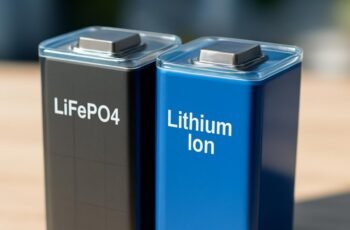
Like a chess game where each move defines the outcome, selecting the right battery type hinges on understanding their fundamental differences. Lifepo4 and NMC batteries each bring unique strengths and challenges, making the choice far from straightforward. As we analyze their performance, safety, and longevity, it becomes clear that the decision depends heavily on specific application requirements. Exploring these aspects can reveal which technology better aligns with your needs—and why that matters.
Key Takeaways
- Lifepo4 offers superior thermal stability and longer cycle life, ideal for safety-critical and long-term applications.
- NMC provides higher energy density and faster charging, suitable for portable electronics and high-performance EVs.
- Lifepo4 has lower capacity efficiency but better durability and safety compared to NMC.
- NMC batteries are more sensitive to thermal management, with a shorter lifespan than Lifepo4.
- Cost-wise, Lifepo4 may have higher upfront costs but lower maintenance over its lifespan.
What Are Lifepo4 and NMC Batteries? An Overview of Key Differences
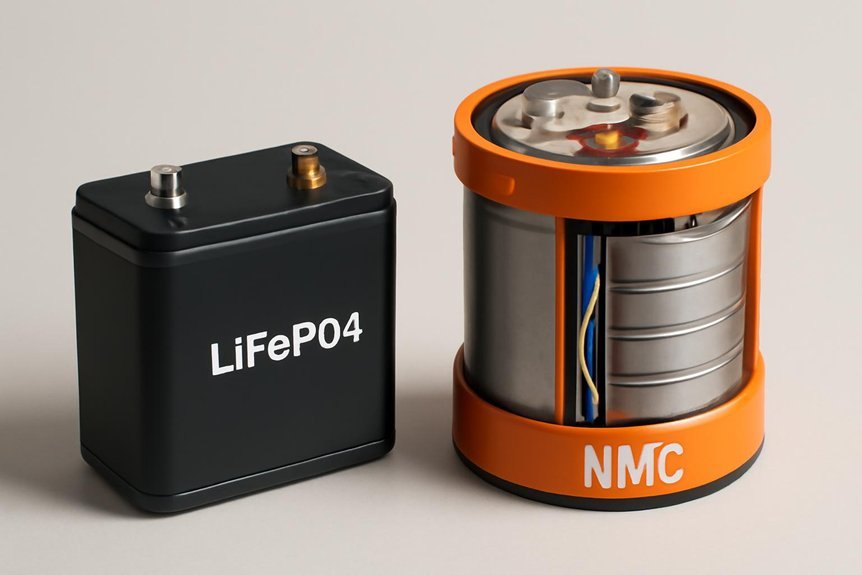
Lifepo4 and NMC batteries are two prevalent lithium-ion chemistries, each optimized for specific applications based on their electrochemical properties. LiFePO4 advantages include enhanced thermal stability, longer cycle life, and improved safety, making them ideal for stationary storage, electric vehicles, and renewable energy systems. Conversely, NMC batteries are favored for their high energy density, which supports applications like portable electronics and EVs where space and weight are critical. While NMC offers higher capacity, it tends to have a shorter lifespan and more thermal management considerations. Understanding these differences helps in selecting the appropriate chemistry: Lifepo4 for safety and longevity, NMC for higher capacity and versatility in diverse applications.
Comparing Performance: Capacity, Charging, and Discharge Rates
When comparing capacity, charging, and discharge rates, it becomes clear that different lithium-ion chemistries excel in distinct operational areas. Lifepo4 batteries generally have lower capacity efficiency compared to NMC, but they offer superior thermal stability, which enhances safe operation under high load conditions. NMC batteries typically deliver higher energy density and faster charging capabilities, making them suitable for applications demanding rapid power delivery. Discharge rates favor NMC in high-current scenarios, whereas Lifepo4’s stable chemistry maintains consistent performance over multiple cycles. Overall, the choice depends on the specific performance priorities: NMC for higher capacity and quick charging, Lifepo4 for enhanced thermal stability and longevity, with a trade-off in capacity efficiency. Understanding these differences helps optimize system performance and reliability.
Safety and Durability: Which Battery Is Safer for Your Application?
While both Lifepo4 and NMC batteries are widely used in various applications, their safety profiles and durability characteristics differ markedly. Lifepo4 batteries excel in thermal stability due to their robust chemical properties, reducing risks of thermal runaway. Conversely, NMC batteries, with higher energy density, pose increased safety concerns under extreme conditions. Key considerations include:
Lifepo4 offers superior safety and durability compared to NMC’s higher energy density risks.
- Thermal stability: Lifepo4’s resilience minimizes overheating risks.
- Chemical properties: Lifepo4’s stable chemistry offers enhanced safety margins.
- Durability: Lifepo4 batteries typically withstand more charge-discharge cycles.
- Safety performance: NMC batteries are more susceptible to thermal runaway without proper management.
Understanding these differences helps determine which battery aligns best with safety and durability requirements for specific applications.
Lifespan and Maintenance: How Long Do These Batteries Last?
Battery lifespan and maintenance requirements greatly influence long-term performance and total cost of ownership. Lifepo4 and NMC batteries typically offer different battery longevity profiles, with Lifepo4 lasting around 2,000 to 5,000 cycles and NMC roughly 1,000 to 2,500 cycles. Proper maintenance tips, like avoiding deep discharges and maintaining ideal charge levels, can extend their lifespan. Regular monitoring of voltage and temperature also helps prevent premature degradation. Below is a comparison highlighting key aspects:
| Aspect | Lifepo4 | NMC |
|---|---|---|
| Typical cycle life | 2,000–5,000 cycles | 1,000–2,500 cycles |
| Maintenance needs | Minimal, stable chemistry | Moderate, sensitive to conditions |
| Battery longevity | Longer, robust | Moderate, shorter lifespan |
| Key maintenance tips | Avoid overcharging/discharging | Regular calibration and cooling |
Adhering to these maintenance tips guarantees ideal battery longevity and performance.
Which Battery Should You Choose? Factors to Consider for Your Needs
Deciding between Lifepo4 and NMC batteries hinges on a careful assessment of your specific application requirements, performance expectations, and budget constraints. For application scenarios demanding long cycle life and safety, Lifepo4 is advantageous, despite higher initial costs. Conversely, NMC batteries excel in high energy density environments where weight and space are critical. Cost considerations also influence choice; Lifepo4 batteries tend to have higher upfront costs but lower maintenance and replacement expenses. Factors like charging time, thermal stability, and environmental conditions further impact suitability. To determine the best fit, evaluate:
- Application scenarios (e.g., EVs, stationary storage)
- Performance priorities (lifespan, energy density)
- Budget constraints
- Environmental and safety requirements
Frequently Asked Questions
Are Lifepo4 and NMC Batteries Environmentally Friendly?
We believe Lifepo4 and NMC batteries have different sustainability impacts; Lifepo4 offers higher energy efficiency and longer lifespan, reducing environmental footprint, while NMC’s material extraction poses more ecological concerns. Both can be environmentally friendly with proper management.
How Do Temperature Variations Affect Battery Performance?
Ever wondered how temperature impact influences performance metrics? We find that extreme temperatures can greatly degrade battery performance, causing efficiency loss and capacity reduction, emphasizing the importance of ideal thermal management in maintaining consistent, reliable operation.
Can These Batteries Be Recycled Easily?
We believe these batteries can be recycled more easily through established recycling processes, which help recover valuable materials, ultimately extending their lifespan and promoting sustainability. Efficient recycling is essential for reducing environmental impact and maximizing resource utilization.
What Are the Initial Costs of Lifepo4 Versus NMC Batteries?
While Lifepo4 batteries typically have higher initial costs due to advanced chemistry, NMC batteries often cost less upfront but may involve higher long-term maintenance. Pricing factors include material costs, manufacturing complexity, and energy density, influencing overall cost comparison.
Are There Specific Applications Where One Battery Type Is Preferred?
We prefer Lifepo4 batteries for automotive applications due to their superior thermal stability and safety, while NMC batteries excel in large-scale energy storage because of their higher energy density and longer cycle life, making each ideal for specific needs.
Conclusion
In summary, choosing between Lifepo4 and NMC batteries is like selecting the right tool for a specific task—each has its strengths. While Lifepo4 offers unmatched safety and longevity, NMC provides high energy density for mobility and quick charging. As we’ve seen, understanding your application’s demands guarantees peak performance. Like a seasoned navigator, making an informed choice guides you toward reliable, efficient energy solutions tailored to your unique needs.