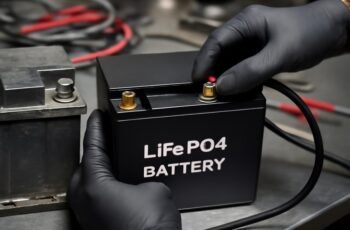
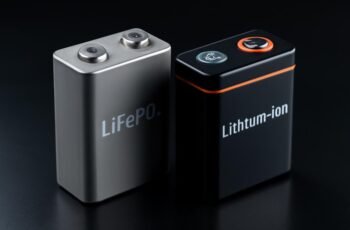
Many assume all lithium-based batteries are interchangeable, but this isn’t entirely accurate. The distinctions between LiFePO4 and Li-ion chemistries greatly impact safety, longevity, and performance. Understanding these differences is vital for making informed choices in applications ranging from portable electronics to renewable energy systems. To determine which battery type best suits your needs, it’s essential to examine their specific characteristics and trade-offs.
Key Takeaways
- LiFePO4 batteries have longer cycle life and better thermal stability than Li-ion batteries.
- Li-ion batteries offer higher energy density, making them suitable for portable electronics.
- LiFePO4 batteries are safer with lower risk of thermal runaway and hazardous reactions.
- LiFePO4 has higher initial costs but lower long-term maintenance and replacement expenses.
- Li-ion batteries are preferred for compact, lightweight applications, while LiFePO4 suits off-grid and safety-critical uses.
What Are the Main Differences Between LiFePO4 and Li-Ion Batteries?
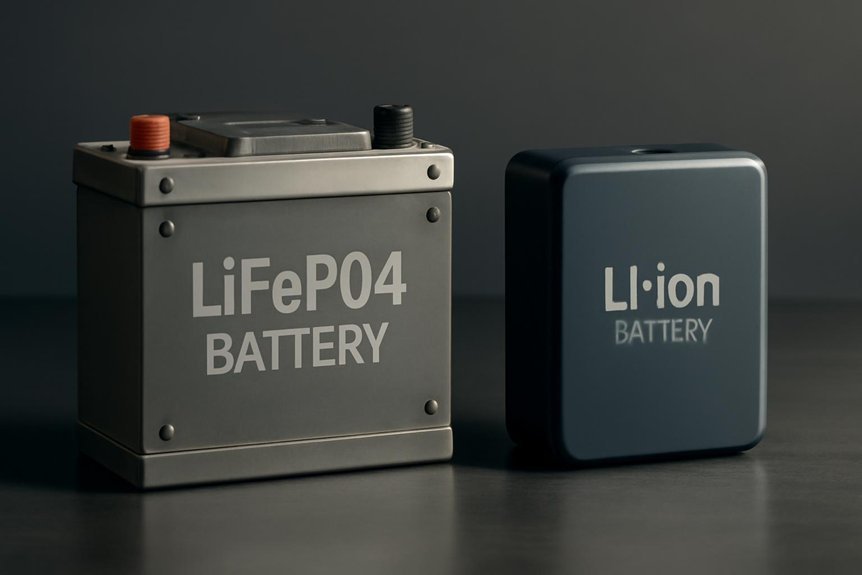
While both LiFePO4 and Li-ion batteries are popular rechargeable energy storage options, they differ considerably in chemistry, performance, and safety characteristics. LiFePO4 batteries typically offer higher battery efficiency and longer cycle life, but they have lower energy density compared to Li-ion batteries, which limits their use in applications requiring compact power sources. Regarding cost effectiveness, LiFePO4 batteries often have higher upfront costs but lower maintenance expenses over time. Charging speed varies, with LiFePO4 batteries generally charging more slowly but providing better temperature tolerance, making them suitable for demanding usage scenarios like solar energy storage and electric vehicles. Conversely, Li-ion batteries excel in portable electronics, where high energy density and rapid charging are prioritized.
How Do Lithium Iron Phosphate and Lithium-Ion Batteries Perform in Terms of Safety?
Lithium Iron Phosphate (LiFePO4) batteries exhibit superior thermal stability, reducing the risk of thermal runaway and enhancing safety. In contrast, traditional lithium-ion batteries pose a higher risk of fire or explosion under fault conditions due to their chemical makeup. Understanding these safety profiles is essential for selecting batteries suited to specific applications.
Thermal Stability and Safety
Understanding the safety profiles of lithium-based batteries is essential, especially when considering their thermal stability. Lithium iron phosphate (LiFePO₄) batteries exhibit superior temperature tolerance, maintaining stability across a broader range and resisting thermal runaway. This stability stems from their robust chemical structure, which minimizes hazardous chemical reactions at elevated temperatures. In contrast, lithium-ion (Li-ion) batteries are more sensitive to temperature fluctuations, with chemical reactions accelerating under thermal stress, increasing safety risks. LiFePO₄’s chemical stability reduces the likelihood of thermal decomposition, making it inherently safer in high-temperature environments. Overall, LiFePO₄ batteries demonstrate enhanced thermal stability and safety due to their resilient chemistry, whereas Li-ion batteries require careful thermal management to mitigate safety concerns.
Risk of Fire or Explosion
The propensity of a battery to catch fire or explode considerably impacts its safety profile, especially under fault or abuse conditions. Lithium iron phosphate (LiFePO₄) batteries exhibit lower fire hazards and explosion risks due to their stable chemical composition and robust thermal stability. They are less prone to thermal runaway, reducing the likelihood of catastrophic failure. In contrast, lithium-ion (Li-ion) batteries, which use layered cathode materials, are more susceptible to internal short circuits and overheating, increasing their fire hazards. Under extreme conditions, Li-ion batteries can ignite or explode, posing significant safety concerns. Overall, LiFePO₄ batteries demonstrate a markedly safer profile, with minimized risks of fire and explosion, making them preferable in applications where safety is paramount.
Which Battery Chemistry Offers Better Longevity and Cycle Life?
Although both Lifepo4 and Li-ion batteries are popular choices for energy storage, Lifepo4 batteries generally demonstrate superior longevity and cycle life. This advantage stems from their chemical stability and lower degradation rates, which influence key longevity factors. Lifepo4’s stable cathode chemistry minimizes capacity fade over repeated charge-discharge cycles, resulting in a higher cycle life. In contrast, Li-ion batteries, especially those using cobalt-based cathodes, tend to experience faster capacity loss due to ongoing electrode degradation. The inherent structural robustness of Lifepo4 contributes to its extended cycle life, often exceeding 2,000 cycles, whereas typical Li-ion batteries average around 500 to 1,000 cycles. Consequently, Lifepo4 batteries are better suited for applications demanding long-term durability and frequent cycling.
How Do Cost and Value Compare Between LiFePO4 and Li-Ion Batteries?
While Lifepo4 batteries excel in longevity and cycle life, their cost and overall value, assessed through detailed cost analysis, greatly impact their application viability compared to Li-ion batteries. Lifepo4 cells typically have a higher upfront cost due to manufacturing complexities and raw material expenses. However, their extended cycle life and superior thermal stability contribute to a more favorable long-term value assessment, reducing replacement and maintenance costs. Conversely, Li-ion batteries often offer lower initial prices but may incur higher lifetime costs due to shorter cycle life and potential safety concerns. As a result, the cost analysis reveals that Lifepo4 batteries provide greater value for applications prioritizing durability and safety, while Li-ion batteries may be more economically attractive for short-term or cost-sensitive projects.
Which Battery Type Is More Suitable for Portable Devices and Consumer Electronics?
When selecting batteries for portable devices and consumer electronics, understanding the distinct characteristics of LiFePO4 and Li-ion batteries is essential. Li-ion batteries are preferred for portable electronics due to their high energy density, lightweight design, and compact form factor, enabling longer usage times in consumer gadgets. They also provide rapid charge capabilities, which are critical for modern portable devices. Conversely, LiFePO4 batteries, with their superior thermal stability and longer cycle life, are less suitable for lightweight consumer electronics but excel in applications requiring durability and safety. For everyday portable electronics, Li-ion batteries are more suitable because of their higher energy density and efficiency. However, for durable consumer gadgets with demanding safety and longevity requirements, LiFePO4 batteries may be advantageous.
When Should You Choose LiFePO4 for Your Off-Grid or Renewable Energy System?
LiFePO4 batteries are often the preferred choice for off-grid and renewable energy systems due to their safety, stability, and longevity. They are ideal when the system demands high safety standards and long cycle life. Consider choosing LiFePO4 if:
- You need batteries with excellent off grid advantages, including stable performance in remote locations.
- Your setup requires high renewable energy suitability, supporting consistent cycling and deep discharge without degradation.
- Longevity and safety are priorities, especially in environments with temperature fluctuations or where fire risk mitigation is critical.
These qualities make LiFePO4 advantageous for applications like solar storage, wind energy, and microgrids, ensuring reliable, efficient, and safe energy management in off-grid scenarios.
How Do Charging and Maintenance Requirements Differ for Each Battery Chemistry?
Charging protocols for Lifepo4 and Li-ion batteries differ greatly, with Lifepo4 requiring specific voltage limits and balanced charging to guarantee longevity. Maintenance frequency varies, as Lifepo4 batteries generally demand less attention, while Li-ion systems need regular checks for capacity and electrolyte integrity. Safety and handling guidelines also diverge, with Lifepo4 being more stable and less prone to thermal runaway, whereas Li-ion batteries necessitate careful management to prevent hazards during charging and storage.
Charging Protocols Variations
Because each battery chemistry responds differently to charging protocols, understanding these variations is crucial for ideal performance and longevity. The protocol differences greatly influence charging efficiency and battery health. For Lifepo4 batteries, we observe:
- A recommended constant current/constant voltage (CC/CV) approach, with a lower voltage cutoff (~3.65V per cell) to prevent overcharging.
- No need for balancing circuits, as Lifepo4 cells are inherently stable and resist voltage imbalance.
- Strict adherence to charge termination once full capacity is reached, minimizing overcharge risks.
In contrast, Li-ion batteries often require:
- Higher voltage cutoffs (~4.2V per cell) to maximize capacity.
- Active balancing during charging to guarantee uniform cell voltage.
- Precise control of charge rates to enhance charging efficiency and prolong lifespan.
These protocol differences are critical for maintaining battery integrity.
Maintenance Frequency Differences
Although both Lifepo4 and Li-ion batteries require regular maintenance to guarantee peak performance, their maintenance frequencies differ considerably due to their distinct chemistries. Lifepo4 batteries typically need less frequent maintenance, primarily involving periodic capacity checks and terminal cleaning to prevent corrosion. In contrast, Li-ion batteries demand more consistent maintenance, such as monitoring voltage levels and balancing cells to avoid capacity loss. These differences influence maintenance costs and tips, with Lifepo4 batteries offering lower ongoing expenses due to reduced intervention.
| Battery Type | Recommended Maintenance Frequency | Key Maintenance Tips |
|---|---|---|
| Lifepo4 | Every 6-12 months | Check terminals, monitor capacity |
| Li-ion | Every 3-6 months | Cell balancing, voltage checks |
Safety and Handling Guidelines
Safety and handling protocols for Lifepo4 and Li-ion batteries differ markedly due to their distinct chemistries and electrochemical behaviors. Lifepo4 batteries are inherently safer, exhibiting lower thermal runaway risk, but still require proper handling. Li-ion batteries, with their higher energy density, demand strict precautions during charging and maintenance.
Key guidelines include:
- Conduct thorough safety training for personnel to minimize risks during charging, disassembly, and battery disposal.
- Use compatible chargers and adhere to manufacturer specifications for both chemistries to prevent overcharging or overheating.
- Implement proper battery disposal procedures, especially for Li-ion cells, to avoid environmental hazards and potential safety incidents.
Understanding these distinctions guarantees safe handling and mitigates risks associated with battery failure or mishandling.
What Are the Environmental Impacts of Lithium Iron Phosphate vs. Lithium-Ion Batteries?
Lithium iron phosphate (LiFePO₄) and lithium-ion (Li-ion) batteries differ markedly in their environmental impacts, primarily due to the materials used and their manufacturing processes. LiFePO₄ batteries have a lower pollution impact because they contain non-toxic, stable cathode materials, reducing concerns during battery disposal and recycling processes. Their resource extraction involves less environmentally damaging mining, resulting in a smaller carbon footprint. Conversely, Li-ion batteries rely on cobalt and nickel, which pose significant environmental and ethical challenges. Lifecycle assessments show LiFePO₄ batteries generally have a reduced environmental footprint, especially when considering renewable sourcing and end-of-life battery disposal. Stricter environmental regulations further favor LiFePO₄, as their safer chemistry simplifies recycling and mitigates pollution impact during disposal.
Which Battery Chemistry Is Better for High-Performance and Heavy-Duty Applications?
When evaluating batteries for high-performance and heavy-duty applications, we find that the chemistry markedly influences their suitability. Lifepo4 and Li-ion batteries differ notably in key performance metrics, impacting their application suitability.
- Energy density: Li-ion batteries typically offer higher energy density, enabling longer operation times in demanding tasks.
- Cycle life: Lifepo4 batteries exhibit superior cycle life, making them more reliable for repetitive, heavy-duty use.
- Thermal stability and safety: Lifepo4’s enhanced thermal stability reduces risks under high loads, essential for safety in high-performance applications.
Choosing the appropriate chemistry depends on whether the priority is maximum energy storage or durability under intense operational conditions.
Frequently Asked Questions
How Do Temperature Ranges Affect Lifepo4 and Li-Ion Battery Performance?
Temperature ranges greatly influence battery thermal stability and performance degradation; Li-ion batteries perform best in moderate temperatures, while Lifepo4 batteries offer better stability at higher temperatures, reducing performance loss and extending lifespan under thermal stress.
Can Lifepo4 Batteries Be Recycled More Easily Than Li-Ion Batteries?
We believe Lifepo4 batteries are easier to recycle due to their stable chemistry, enabling simpler recycling processes and reducing environmental impact, compared to Li-ion batteries, which contain more hazardous materials requiring complex procedures and posing higher ecological risks.
What Are the Weight Differences Between Lifepo4 and Li-Ion Batteries?
We find that Lifepo4 batteries are generally heavier than Li-ion batteries due to lower energy density, impacting weight comparison markedly. This difference affects design choices where weight is essential, despite Lifepo4’s advantages in safety and lifespan.
How Do Charging Speeds Compare for Lifepo4 and Li-Ion Batteries?
We find that Li-ion batteries typically charge faster due to higher peak currents and superior charging efficiency, though Lifepo4 batteries offer more stable, safer charging profiles. This impacts overall charging time and thermal management strategies.
Are There Specific Applications Where One Chemistry Outperforms the Other?
We find LiFePO4 excels in solar applications and energy storage due to its longer cycle life—up to 2,000 cycles—while Li-ion batteries outperform in electric vehicles and power tools with higher energy density and faster charging capabilities.
Conclusion
In our experience, choosing the right battery is like selecting the right tool for a job—we need durability, safety, and efficiency. Just as a sturdy scaffold supports a building’s height, LiFePO4 batteries provide long-term stability for demanding projects. Meanwhile, Li-ion batteries are like a lightweight ladder—perfect for quick, portable needs. Understanding these differences helps us build safer, more reliable energy solutions tailored to each application’s demands.