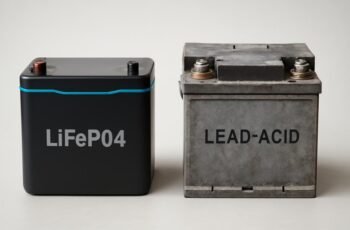
When comparing the safety profiles of LiFePO4 and traditional lithium-ion batteries, it’s essential to examine their fundamental chemistry and failure modes. LiFePO4’s stable phosphate cathode offers inherent thermal stability, reducing risks associated with overheating. Conversely, lithium-ion batteries with cobalt-based cathodes are more prone to thermal runaway, especially under stress. Understanding these differences can influence critical decisions, but the question of which is safer remains complex—there are factors that might surprise you.
Key Takeaways
- Lifepo4 batteries have a more stable chemical structure, reducing thermal runaway risk compared to lithium-ion batteries.
- They resist high temperatures better, lowering the chances of fire or explosion during abuse conditions.
- Lifepo4’s phosphate-based cathode enhances thermal stability and safety margin.
- They are less prone to dendrite formation and internal shorts, which can cause failures in lithium-ion batteries.
- Despite lower energy density, Lifepo4 batteries offer a safer option for high safety margin applications.
How Do Lifepo4 and Lithium-Ion Batteries Differ in Safety Features?
How do Lifepo4 and lithium-ion batteries differ in their safety features? The key distinction lies in their chemical composition and thermal stability. Lifepo4 batteries utilize a phosphate-based cathode, which provides greater thermal stability compared to the cobalt-based cathodes in lithium-ion batteries. This improved stability reduces the risk of thermal runaway, a condition that can lead to fires or explosions. Lithium-ion batteries are more prone to overheating due to their chemical makeup, which can release oxygen at elevated temperatures. In contrast, Lifepo4’s stable chemical structure resists high temperatures, making it inherently safer. This enhanced thermal stability means Lifepo4 batteries are less likely to experience catastrophic failure, providing a safer option for applications demanding high safety margins.
What Causes Lithium-Ion Batteries to Fail or Fire?
Lithium-ion batteries, while widely used for their high energy density and efficiency, are susceptible to failure and fire primarily due to internal chemical and thermal instabilities. Central to these failures is thermal runaway, a rapid, uncontrolled increase in temperature caused by exothermic reactions that can ignite the battery. Electrolyte instability plays a significant role here; when the electrolyte decomposes under high temperatures or electrical stress, it produces flammable gases and heat, fueling thermal runaway. Additionally, internal short circuits—resulting from manufacturing defects, mechanical damage, or dendrite formation—can trigger localized heating, further destabilizing the electrolyte. These interconnected factors create a cascade effect, ultimately leading to catastrophic failure or combustion, highlighting the critical importance of understanding and mitigating these internal vulnerabilities.
Are Lifepo4 Batteries Less Prone to Overheating and Fires?
Although lithium iron phosphate (LiFePO4) batteries tend to be more thermally stable than traditional lithium-ion chemistries, their resistance to overheating and fires arises from specific chemical and structural advantages. The chemical composition confers superior thermal stability, reducing the risk of thermal runaway—a primary cause of battery fires. Structurally, LiFePO4’s robust crystal lattice limits the release of oxygen during overheating, enhancing fire resistance. This inherent stability makes them less prone to catastrophic failures under thermal stress. Additionally, their lower propensity for exothermic reactions during abuse conditions further minimizes fire risk. Consequently, LiFePO4 batteries exhibit a markedly reduced likelihood of overheating and combustion, establishing them as a safer alternative in applications where thermal safety is paramount.
How Do Durability and Lifecycle Impact Battery Safety?
Durability and lifecycle greatly influence battery safety because they determine how well a battery can withstand repeated use and environmental stresses without degrading or failing prematurely. Higher battery longevity reduces the risk of capacity loss, internal shorts, or thermal instability over time. Thermal stability is also essential, as degraded cells are more prone to overheating, which can lead to safety hazards. The following table compares these factors:
| Aspect | Impact on Safety |
|---|---|
| Battery longevity | Longer-lasting batteries maintain integrity, reducing failure risk |
| Thermal stability | Stable cells prevent overheating, fires, and explosions |
| Degradation rate | Slower degradation minimizes safety concerns over time |
| Environmental resilience | Better resistance to stressors enhances safety longevity |
| Material quality | Higher quality materials improve durability and safety |
What Are the Risks and Limitations of Lifepo4 Batteries?
While LiFePO4 (lithium iron phosphate) batteries are praised for their safety and long cycle life, they also present specific risks and limitations that warrant careful consideration. The primary Lifepo4 disadvantages include their lower energy density compared to traditional lithium-ion chemistries, which can limit applications requiring compact or lightweight solutions. Lifepo4 costs tend to be higher initially, though this is offset by longer lifespan and stability. Their performance may degrade under extreme temperatures, affecting reliability in harsh environments. Additionally, Lifepo4 applications are often constrained by the need for specialized charging systems and management protocols. Despite their safety benefits, these limitations highlight the importance of evaluating whether Lifepo4 technology aligns with specific operational requirements and cost-effectiveness.
Which Battery Technology Is Safer for Your Specific Use Case?
Determining which battery technology is safest for your specific use case requires a thorough assessment of operational conditions, safety standards, and potential risks. Different battery applications demand tailored safety considerations; for example, high-power applications may benefit from Lifepo4’s thermal stability, while portable electronics might prioritize energy density. Safety standards such as UL or IEC certifications help guide safe deployment, but understanding the intrinsic properties of each chemistry is vital. Lithium-ion batteries, with their higher energy density, pose increased thermal runaway risks if not properly managed. Conversely, Lifepo4 batteries offer enhanced safety margins due to their stable chemistry, making them preferable in environments where safety is paramount. Ultimately, selecting the safest option depends on balancing these factors against your specific operational needs.
Frequently Asked Questions
How Do Manufacturing Defects Affect Battery Safety?
Manufacturing defects, such as improper assembly or material inconsistencies, compromise battery safety by causing short circuits or thermal runaway. Variations in manufacturing processes directly impact defect types, emphasizing the need for rigorous quality control to prevent safety hazards.
Can External Damage Cause Li-Ion or Lifepo4 Battery Fires?
We find that 80% of lithium-ion fires result from external damage causing thermal runaway or battery puncture; Lifepo4 batteries are less prone, but both can ignite if compromised, emphasizing the importance of careful handling and safety measures.
Are Lifepo4 Batteries Safer for High-Temperature Environments?
We believe LiFePO4 batteries are safer in high-temperature environments due to their superior thermal stability and higher temperature tolerance, reducing risk of thermal runaway. Their inherent chemical stability makes them more reliable under elevated heat conditions.
What Safety Certifications Are Required for Battery Production?
Like a ship needing a compass, battery production demands strict certification processes. We adhere to essential battery standards, ensuring safety certifications are met, which guarantees our products’ reliability and safety in diverse applications through rigorous testing and compliance.
How Do Battery Management Systems Influence Overall Safety?
We believe battery management systems enhance safety through precise thermal management and voltage regulation, preventing overheating and overcharging. These systems critically maintain ideal performance, reduce risks, and guarantee the overall safety of Lifepo4 and lithium-ion batteries.
Conclusion
To summarize, LiFePO4 batteries generally offer a higher safety profile due to their stable chemistry and thermal resilience. For instance, in electric vehicle applications, LiFePO4 packs have demonstrated fewer thermal runaway incidents compared to cobalt-based lithium-ion batteries. This safety margin makes them a preferable choice in high-risk environments or where safety is paramount. Ultimately, understanding these differences helps us select the most reliable, secure energy storage solution tailored to our specific needs.