When comparing Lifepo4 and lithium-ion batteries, understanding their lifespan differences is essential for making informed energy storage choices. We analyze their chemical stability, cycle life, and resilience under various conditions to determine which technology offers greater longevity. While Lifepo4 promises a significantly higher number of charge cycles, real-world performance depends on several factors. Let’s explore these variables to see which battery type truly stands the test of time.
Key Takeaways
- Lifepo4 batteries typically last over 2,000 cycles, outperforming lithium-ion batteries’ 500-1,000 cycles.
- Lifepo4 maintains stable chemistry, reducing capacity fade over time compared to lithium-ion.
- Rapid charging and high temperatures accelerate degradation in lithium-ion batteries more than in Lifepo4.
- Proper storage and moderate use extend Lifepo4’s lifespan, making it more durable long-term.
- Lifepo4’s slower capacity loss results in more reliable performance over many charge cycles.
How Do Lifepo4 and Lithium-Ion Batteries Differ in Overall Lifespan?
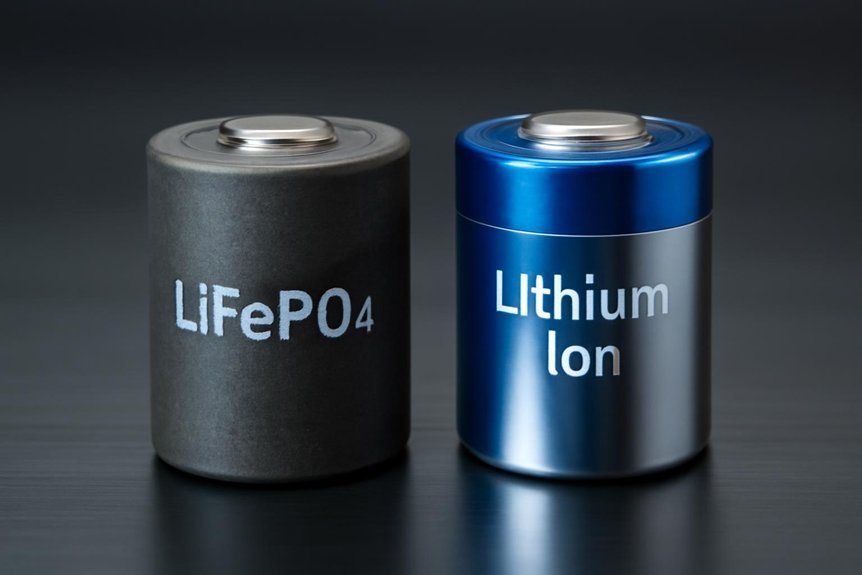
Although both LiFePO4 and lithium-ion batteries are widely used for energy storage, their overall lifespans differ considerably due to their chemical compositions and cycle durability. Lifepo4 advantages include a strikingly longer cycle life, often exceeding 2,000 charge cycles, compared to typical lithium-ion batteries. This durability stems from its stable chemistry, which reduces capacity fade over time. Conversely, lithium-ion drawbacks involve faster capacity degradation, especially under high charge rates or elevated temperatures, leading to a shorter lifespan. While lithium-ion batteries may initially offer higher energy density, their reduced cycle life impacts long-term reliability. Overall, Lifepo4’s inherent stability and cycle longevity make it more suitable for applications demanding sustained performance, highlighting the significant lifespan advantage over traditional lithium-ion technologies.
Factors That Influence Battery Longevity and How They Vary by Type
Battery longevity is primarily influenced by a combination of chemical stability, operating conditions, and usage patterns, all of which impact the degradation mechanisms over time. Charging habits considerably affect lifespan; frequent, rapid charging accelerates capacity loss, especially in lithium-ion batteries. Temperature effects are critical—excessive heat speeds up chemical degradation, while cold temperatures can hinder performance. Discharge rates also matter; high discharge rates induce stress and reduce cycle life, particularly in lithium-ion types. Proper storage conditions, such as maintaining a moderate charge level and cool environment, help preserve longevity. Manufacturing quality impacts durability by ensuring consistent material integrity and minimizing defects. Overall, understanding these factors helps optimize battery lifespan, with variations tied closely to the specific chemical compositions and structural designs of Lifepo4 versus lithium-ion batteries.
Comparing the Expected Cycle Life of Lifepo4 and Lithium-Ion Batteries
When comparing the expected cycle life of Lifepo4 and lithium-ion batteries, it becomes clear that Lifepo4 generally offers a longer lifespan regarding charge-discharge cycles. This advantage stems from superior cycle performance and lower degradation rates, which enable Lifepo4 batteries to sustain a higher number of cycles before capacity diminishes considerably. While lithium-ion batteries typically endure around 500-1,000 cycles, Lifepo4 batteries often surpass 2,000 cycles under ideal conditions. The slower degradation rates of Lifepo4 result from more stable chemical structures, reducing capacity loss over time. Consequently, Lifepo4 batteries are better suited for applications demanding long-term durability and frequent cycling, providing a more cost-effective and reliable energy storage solution over the lifespan of the battery.
Maintenance Tips to Maximize Battery Lifespan for Both Types
To maximize the lifespan of both Lifepo4 and lithium-ion batteries, regular maintenance practices are essential for minimizing degradation and ensuring peak performance. Proper charging techniques, such as avoiding full charges or discharges outside recommended voltage ranges, help reduce stress on battery cells. Ideal storage conditions—cool, dry environments with partial charge levels—prevent capacity loss over time. Temperature effects are critical; high temperatures accelerate chemical degradation, while low temperatures can impede performance; maintaining moderate temperatures is crucial. Managing discharge rates, avoiding rapid or deep discharges, preserves cell integrity. Consistent usage patterns and routine maintenance routines—like periodic calibration and monitoring voltage levels—further mitigate aging effects. These practices collectively extend battery lifespan by reducing thermal, chemical, and mechanical stresses.
Which Battery Lasts Longer in Real-World Use? A Practical Performance Comparison
Have we truly seen which type outperforms the other in everyday conditions? In real-world applications, Lifepo4 batteries often demonstrate longer-lasting performance due to their stable chemistry and resilience to frequent charging habits. Lithium-ion batteries, while offering higher energy density, tend to degrade faster under similar conditions, especially when subjected to rapid charging or deep discharges. Our analysis indicates that Lifepo4’s cycle life remains more consistent despite variations in usage patterns, making them more reliable in practical scenarios. Conversely, lithium-ion batteries may show a decline in capacity sooner if charging habits are aggressive or inconsistent. Ultimately, the real-world performance hinges on these factors, but Lifepo4’s durability generally translates into a longer effective lifespan in everyday use.
Frequently Asked Questions
How Do Temperature Fluctuations Affect Lifepo4 and Lithium-Ion Battery Lifespan?
Temperature effects greatly impact battery lifespan; LiFePO4 exhibits superior thermal stability, enduring wider temperature ranges with minimal degradation, whereas lithium-ion batteries suffer faster capacity loss under temperature fluctuations, emphasizing the importance of temperature control for ideal longevity.
What Are the Safety Considerations Impacting Battery Longevity?
We prioritize safety considerations like maintaining cycle stability and effective thermal management, which prevent thermal runaway and degradation, directly impacting battery longevity. Proper handling and monitoring are essential for ideal performance and extended lifespan of both battery types.
How Do Charging Speed and Power Impact Battery Lifespan?
Charging speed and power greatly influence battery lifespan by affecting charging cycles and thermal stress; effective power management minimizes rapid charging risks, prolonging longevity, while controlled charging rates preserve structural integrity and optimize overall battery health.
Are There Specific Applications Where One Battery Type Outperforms the Other?
Think of batteries as athletes; Lifepo4 shines in industrial applications, marine use, and energy storage due to longevity and safety, while lithium-ion excels in portable electronics and electric vehicles for high energy density and rapid charging capabilities.
How Does Depth of Discharge Influence the Lifespan of Both Batteries?
We find that deeper discharge cycles strain battery chemistry, reducing lifespan for both Lifepo4 and lithium-ion batteries. Shallow discharges preserve more cycles, highlighting the importance of managing discharge depth for ideal longevity in different applications.
Conclusion
In our quest for longevity, Lifepo4 emerges as the steadfast warrior, outlasting lithium-ion with resilience rooted in chemical stability. Like the tortoise in the race, its cycle life endures, defying the swift fade of its counterpart. While both require proper care, understanding their intrinsic differences guides us to smarter choices—investing in durability today for reliable, long-term energy storage tomorrow. In this balance of science and strategy, longevity becomes not just a goal, but a measured certainty.