Understanding the charge level of LiFePO4 batteries is essential for optimizing their performance and lifespan. Accurate monitoring helps prevent damaging over-discharge or overcharge conditions, which can compromise safety and efficiency. As we explore the complexities of battery management, it becomes clear that precise tools and proper practices are crucial. Ensuring these measures are in place not only safeguards the system but also extends the service life—yet, the methods to achieve this require careful consideration.
Key Takeaways
- Maintain LiFePO4 batteries between 20% and 80% charge for optimal longevity.
- Use accurate monitoring tools to track voltage, current, and temperature during storage.
- Overcharging or deep discharging can damage the battery and reduce lifespan.
- Regularly check and calibrate charge indicators for precise state of charge readings.
- Employ proper charge regulation and safety mechanisms to prevent overcharge or deep discharge.
What Does the Charge Level of a Lifepo4 Battery Mean?
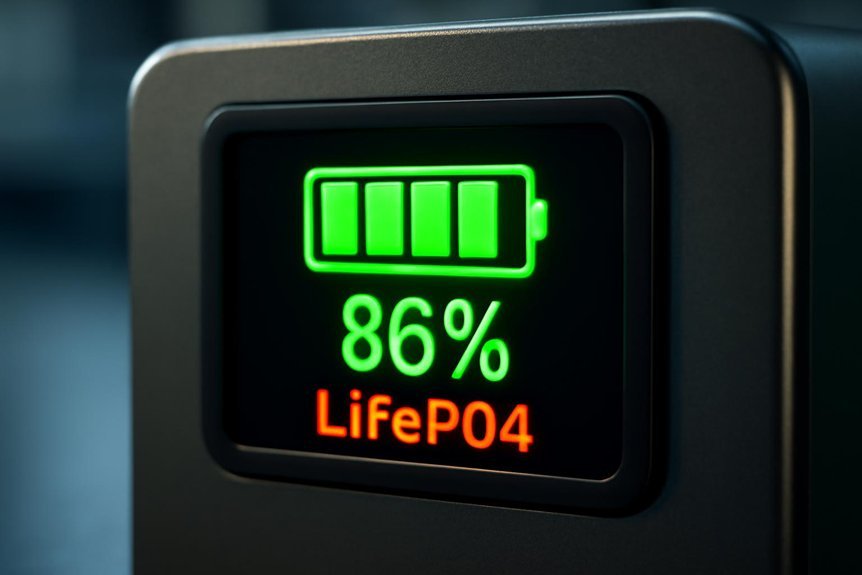
The charge level of a LiFePO4 (lithium iron phosphate) battery indicates the remaining capacity available for use, expressed as a percentage of its total capacity. Accurate interpretation relies on reliable charge indicators integrated within the battery management system (BMS). These indicators monitor voltage, current, and temperature to assess state of charge (SOC), ensuring safe operation and peak performance. Proper understanding of the charge level is essential for effective battery management, preventing over-discharge or overcharge conditions that could damage the cells. By continuously analyzing data from charge indicators, the BMS maintains balance among individual cells, prolonging lifespan and enhancing safety. This technical insight into the charge level helps users make informed decisions about usage and maintenance practices.
How to Accurately Monitor Your Lifepo4 Battery’s Charge Level
To accurately monitor your LiFePO4 battery’s charge level, it’s essential to utilize reliable measurement tools and interpret the data correctly. Proper battery management depends on precise readings, which can be achieved through specific techniques. First, use a high-quality battery monitor with a shunt resistor to measure real-time voltage and current, providing an accurate state of charge. Second, regularly check integrated charge indicators on the battery or system display, ensuring they are calibrated for LiFePO4 chemistry. Third, analyze data trends over time to identify patterns or deviations, enabling proactive management. Combining these methods enhances battery longevity, prevents over-discharge, and maintains peak performance—key aspects of effective battery management.
The Importance of Maintaining Proper Charge Levels for Lifepo4 Batteries
Maintaining the ideal charge range for Lifepo4 batteries is essential to guarantee their longevity and performance. Overcharging poses significant risks, including capacity loss and potential safety hazards. By adhering to proper charge levels, we can maximize battery efficiency and reduce the likelihood of damage.
Optimal Charge Range
Ensuring Lifepo4 batteries operate within their ideal charge range is essential for maximizing longevity and performance. Maintaining proper charge levels prevents capacity fade and enhances cycle life. The optimal usage range typically falls between 20% and 80%, where the battery’s chemical stability is maintained. Charge level indicators help monitor this range, allowing for precise control.
Key points include:
- Staying within the 20–80% window minimizes stress on battery chemistry.
- Proper use of charge level indicators ensures accurate tracking.
- Avoiding deep discharges or full charges supports long-term durability.
Adhering to this optimal charge range is crucial for preserving battery health, optimizing energy efficiency, and reducing degradation over time, thus ensuring reliable performance.
Risks of Overcharging
Overcharging Lifepo4 batteries can greatly compromise their lifespan and safety, as excessive voltage levels induce chemical stress that accelerates degradation. The overcharging effects include increased internal pressure, electrolyte breakdown, and potential thermal runaway, all of which threaten battery integrity. Maintaining proper charge levels is vital for charging safety, as surpassing recommended voltage thresholds can lead to capacity loss, reduced cycle life, and, in extreme cases, safety hazards such as fires. Lifepo4 chemistry is inherently more stable than other lithium-ion variants, but it remains sensitive to overvoltage conditions. Implementing precise charge regulation and safety mechanisms prevents overcharging effects, ensuring the longevity and reliability of the battery system. Proper management of charge levels is essential to mitigate risks and optimize performance.
Methods to Check and Track Lifepo4 Battery State of Charge
To accurately monitor the state of charge (SOC) of a Lifepo4 battery, we must employ precise measurement techniques that reflect its true capacity. Effective battery monitoring relies on accurate data from reliable charge indicators and measurement tools. These methods include:
- Voltage measurement: Using a multimeter to assess terminal voltage, which correlates with SOC within specific ranges.
- Coulomb counting: Tracking charge input and output to determine remaining capacity over time.
- Built-in Battery Management Systems (BMS): Utilizing integrated sensors and algorithms that continuously analyze voltage, current, and temperature for real-time SOC estimation.
Implementing these methods guarantees accurate battery monitoring, informs maintenance decisions, and prevents over-discharge or overcharge scenarios.
Common Signs of Over-Discharging or Overcharging a Lifepo4 Battery
We observe that voltage fluctuations, capacity reduction, and abnormal heating are key indicators of over-discharge or overcharge in Lifepo4 batteries. These signs can compromise battery integrity and performance if not promptly identified. Analyzing these symptoms helps us prevent potential damage and extend battery lifespan.
Battery Voltage Fluctuations
Battery voltage fluctuations serve as critical indicators of a LiFePO4 battery’s health, often signaling over-discharge or overcharge conditions. Variations in voltage can result from fluctuation causes such as inconsistent load impact, inadequate voltage regulation, or poor monitoring tools. These fluctuations directly affect voltage stability, influencing overall battery performance and charging efficiency. Rapid discharge rates may cause voltage dips, while overcharging can lead to voltage spikes, both compromising battery lifespan. Recognizing these signs allows for better energy management and proactive adjustments. Monitoring tools are essential for detecting subtle voltage variations that may not be apparent visually. Addressing voltage fluctuations promptly guarantees peak load management, maintains voltage stability, and preserves the battery’s longevity.
Reduced Battery Capacity
Reduced battery capacity often signals underlying issues caused by over-discharge or overcharge, which can greatly impair a LiFePO4 battery’s performance. Repeated improper charging cycles accelerate capacity degradation, diminishing the battery’s ability to store and deliver energy efficiently. Over-discharge can lead to irreversible chemical changes within the cells, reducing overall capacity, while overcharging causes stress and potential electrolyte breakdown. These conditions shorten the effective lifespan of the battery by increasing the rate of capacity degradation across charging cycles. Monitoring capacity decline helps identify early signs of damage, emphasizing the importance of maintaining proper charge levels. Ultimately, consistent over-discharge or overcharge accelerates deterioration, limiting the battery’s reliable operation and necessitating earlier replacement.
Unusual Battery Heating
Unusual heating of a LiFePO4 battery often indicates underlying issues related to improper charging practices, such as over-discharge or overcharge. This abnormal temperature rise can compromise thermal management systems, leading to localized hotspots and increased risk of thermal runaway. The heat may also be affected by inadequate battery insulation, which impairs heat dissipation.
Key signs include:
- Excessive surface temperature during charging or discharging cycles.
- Uneven heating across the battery pack, signaling poor thermal management.
- Persistent warmth even after the system is idle, indicating internal thermal imbalance.
Monitoring temperature fluctuations is essential, as overheating can damage internal components and shorten lifespan. Proper thermal management and insulation are critical to prevent these issues and maintain safe operation.
Best Practices for Charging and Discharging Your Lifepo4 Battery
To optimize the lifespan and performance of your LiFePO4 battery, it’s essential to follow best practices for charging and discharging. Proper charging techniques involve maintaining voltage levels within recommended ranges, typically around 3.2 to 3.3 volts per cell, to prevent overvoltage stress. Consistent, balanced charging minimizes capacity fade and prolongs cycle life. Discharging strategies should focus on avoiding deep discharges below 20% capacity, as excessive depletion accelerates degradation. Using a controlled, steady discharge rate helps preserve cell integrity and reduces thermal stress. Monitoring voltage, current, and temperature during both processes guarantees safe operation and maximizes battery longevity. Adhering to these optimized charging techniques and discharging strategies enhances performance, safety, and overall battery lifespan.
Tools and Devices to Help Manage Your Lifepo4 Battery’s Charge Level
Effective management of your LiFePO4 battery’s charge level relies on the deployment of specialized tools and devices designed for accurate monitoring and control. These include monitoring devices like voltage meters and mobile apps that provide real-time data, enabling precise battery management. Charge controllers and smart chargers regulate charge flow, preventing overcharging and enhancing lifespan, especially during solar integration. Maintenance tools facilitate regular checks, ensuring system integrity.
- Monitoring devices (voltage meters, mobile apps)
- Charge controllers and smart chargers
- Solar integration and maintenance tools
Together, these tools enhance the efficiency and safety of your battery system, allowing proactive adjustments and minimizing risks associated with incorrect charge levels. Proper deployment of these devices guarantees peak performance and longevity of your LiFePO4 battery.
Troubleshooting Charge Level Issues in Lifepo4 Battery Storage Systems
When a LiFePO4 battery storage system exhibits inconsistent charge levels, it indicates underlying issues that require systematic troubleshooting. Variations in charge levels can accelerate battery degradation, negatively impacting battery lifespan and reducing total charge cycles. First, we verify the accuracy of the state of charge readings, as faulty sensors can mislead diagnostics. Next, we assess the battery management system (BMS) for proper operation, ensuring it protects against over-discharge or overcharge conditions. We also examine the connection integrity, as loose or corroded terminals can cause voltage drops. Additionally, inconsistent charge levels may stem from uneven cell balancing, which can be remedied through active balancing procedures. Addressing these factors helps optimize overall battery performance, prolong lifespan, and maximize the number of charge cycles.
Frequently Asked Questions
How Does Temperature Affect Lifepo4 Battery Charge Levels?
Temperature effects greatly impact Lifepo4 battery charging efficiency; low temperatures reduce ion movement, lowering efficiency, while high temperatures can cause overheating and potential damage, emphasizing the need for ideal thermal management to maintain consistent charge levels.
What Is the Optimal Depth of Discharge for Lifepo4 Batteries?
Think of our Lifepo4 batteries as a marathon runner; to maximize battery lifespan and discharge cycles, we keep depth of discharge around 80%, ensuring longevity while preventing undue stress and preserving overall performance over time.
Can Lifepo4 Batteries Be Left Fully Charged for Long Periods?
We find that leaving LiFePO4 batteries fully charged for extended periods can impact battery lifespan and charge retention negatively. To optimize performance, we recommend maintaining a partial charge and storing batteries in a cool, dry environment.
How Often Should I Calibrate My Lifepo4 Battery Monitor?
We recommend calibrating your LiFePO4 battery monitor every three to six months to guarantee accurate readings, as regular monitor calibration directly impacts battery performance, helping you detect potential issues early and optimize overall system efficiency.
Are There Specific Indicators for Imminent Lifepo4 Battery Failure?
We observe failure signs like rapid capacity decline, abnormal voltage drops, or increased internal resistance, which signal imminent failure and impact battery lifespan. Monitoring these indicators helps us maintain peak performance and extend the battery’s operational life.
Conclusion
Understanding and maintaining proper charge levels in our LiFePO4 batteries is essential for peak performance and longevity. By employing accurate monitoring tools and adhering to best practices, we can prevent potential issues akin to a ship’s captain avoiding stormy seas. Regular checks and proper management guarantee our energy storage systems remain reliable and efficient, much like a well-tuned clockwork. This proactive approach safeguards our investment, keeping our power systems running smoothly through the ages.