When comparing LiFePO4 and lead-acid batteries, the differences in maintenance requirements are significant and can influence long-term operational costs. While LiFePO4 batteries demand far less frequent inspections and simpler upkeep, lead-acid units require more regular and detailed maintenance tasks that can increase downtime and expenses. Understanding these distinctions is essential for optimizing performance and lifespan, but the question remains: which type best fits your specific application and maintenance capacity?
Key Takeaways
- LiFePO4 batteries require inspections every 6-12 months, while lead-acid batteries need maintenance every 1-3 months.
- Lead-acid batteries need electrolyte level checks, topping off, and terminal cleaning regularly.
- LiFePO4 batteries have lower long-term maintenance costs due to fewer required checks and longer lifespan.
- Lead-acid batteries are more sensitive to environmental factors like humidity and dust, demanding stricter maintenance.
- LiFePO4 batteries are suitable for continuous use with minimal upkeep, unlike lead-acid batteries needing frequent attention.
What Are the Key Differences Between Lifepo4 and Lead-Acid Batteries?
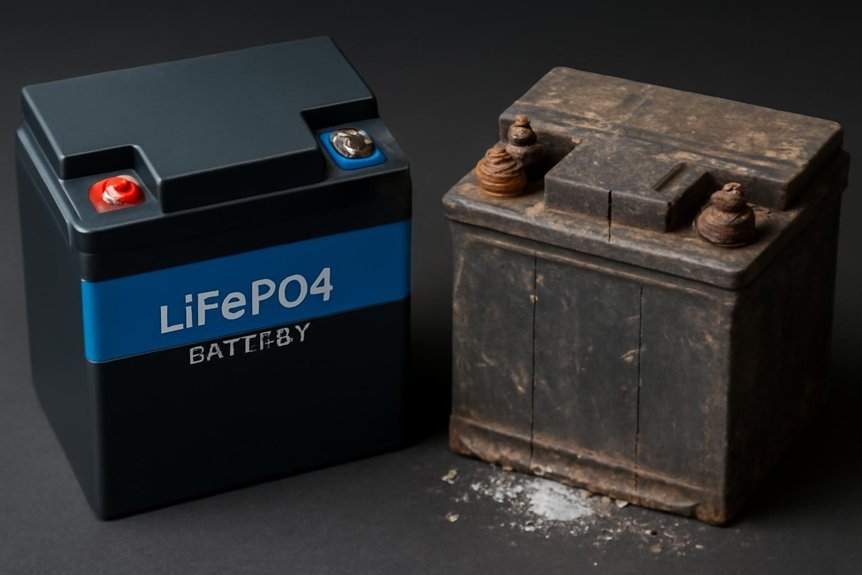
While both LiFePO4 (lithium iron phosphate) and lead-acid batteries serve as reliable energy storage solutions, they differ markedly in chemistry, performance, and maintenance requirements. LiFePO4 offers higher efficiency, translating to better energy retention and faster charge cycles, which enhances overall system performance. Lead acid batteries, however, tend to have limited longevity, with shorter cycle life and more frequent replacements. Regarding safety, LiFePO4 batteries are inherently safer due to their stable chemistry and lower risk of thermal runaway. Additionally, LiFePO4 batteries are considerably lighter, making them ideal for portable applications and installations where weight matters. These differences underscore the importance of selecting the appropriate chemistry based on operational needs and safety considerations.
How Do Maintenance Requirements Differ for Lifepo4 and Lead-Acid Batteries?
Lifepo4 and lead-acid batteries have distinct maintenance schedules, with Lifepo4 units typically requiring less frequent checks due to their stable chemistry. Their charging protocols also differ, as Lifepo4 batteries need specific voltage regulation to prevent damage, unlike lead-acid types that demand regular equalization and watering. Additionally, inspection and care routines vary, with Lifepo4 batteries necessitating minimal electrolyte management, whereas lead-acid batteries require consistent monitoring of electrolyte levels and terminal cleanliness.
Maintenance Frequency Differences
Because maintenance requirements greatly influence overall battery management, understanding the frequency at which each type needs attention is critical for enhancing battery performance. Lifepo4 batteries generally require less frequent maintenance intervals, often needing inspections only every 6 to 12 months. In contrast, lead-acid batteries demand more regular upkeep, typically every 1 to 3 months, to prevent sulfation and electrolyte degradation.
- Lifepo4 batteries benefit from minimal maintenance, with checks primarily focused on physical integrity and voltage consistency.
- Lead-acid batteries require frequent electrolyte level checks and terminal cleaning to maintain peak performance.
- The differing maintenance intervals directly impact operational planning, with Lifepo4 batteries offering more predictable, lower-maintenance performance over time.
Charging Protocol Requirements
Charging protocols are fundamental to maintaining ideal battery health and longevity, with distinct requirements for Lifepo4 and lead-acid types. Lifepo4 batteries demand a precise charging voltage cutoff, typically around 3.65V per cell, to optimize charging efficiency and prevent overcharge damage. They benefit from a CC/CV (constant current/constant voltage) charging method, which sustains high charging efficiency and supports maximum battery lifespan. Conversely, lead-acid batteries require a bulk charge up to approximately 14.4V (for 12V systems), followed by a controlled absorption and float phase to prevent sulfation and electrolyte loss. Proper adherence to these protocols guarantees minimal voltage stress, maximizes charging efficiency, and extends overall battery lifespan, emphasizing the need for tailored charging strategies for each type.
Inspection and Care Needs
While both Lifepo4 and lead-acid batteries require regular inspection and maintenance to confirm peak performance, their specific care needs differ greatly. Lifepo4 batteries demand minimal battery upkeep due to their stable chemistry, but preventive measures still include monitoring voltage levels and guaranteeing proper cooling. Lead-acid batteries, however, require more frequent checks, especially for electrolyte levels and terminal corrosion.
- For Lifepo4, regularly verify voltage and temperature to prevent thermal runaway.
- For lead-acid, top off electrolyte levels and clean terminals to avoid corrosion.
- Implement scheduled equalization and load testing for both types to identify potential issues early.
Adhering to these preventive measures confirms reliable operation and extends the lifespan of each battery type.
What Regular Maintenance Does a Lead-Acid Battery Require?
| Aspect | Action | Tools Needed |
|---|---|---|
| Battery fluid levels | Top up with distilled water | Distilled water, gloves |
| Terminal corrosion | Clean and inspect | Wire brush, terminal cleaner |
| Electrolyte levels | Measure with hydrometer | Hydrometer |
| Charging efficiency | Confirm proper charging | Charger, multimeter |
| Safety precautions | Use protective gear | Gloves, goggles |
How Much Maintenance Does a Lifepo4 Battery Need?
Lifepo4 batteries require consistent charging practices, ensuring they are fully charged without over-discharge to maintain ideal performance. Their longevity depends on proper management of charge cycles and avoiding deep discharges, which can greatly extend service life. Consequently, maintenance frequency is lower compared to lead-acid counterparts, primarily involving routine voltage checks and ensuring balanced cell conditions.
Charging Requirements and Care
Proper charging and maintenance are essential to maximize the lifespan and performance of a Lifepo4 battery. To optimize charging efficiency and extend battery lifespan, we follow specific protocols.
- Maintain voltage limits: Keep charging voltage below 3.65V per cell to prevent overvoltage stress, which can degrade the battery’s internal chemistry.
- Use specialized chargers: Employ chargers designed for Lifepo4 chemistry, guaranteeing a stable, balanced charge cycle with proper current and voltage regulation.
- Avoid deep discharges: Refrain from discharging below 20%, as deep cycles shorten battery lifespan and impair overall performance.
Adhering to these requirements guarantees consistent charging efficiency and preserves the battery’s integrity over time, reducing maintenance needs.
Longevity and Maintenance Frequency
By following recommended charging protocols—such as maintaining voltage limits and using specialized chargers—we can greatly influence the battery’s overall longevity and maintenance needs. Lifepo4 batteries generally offer a longer battery lifespan compared to lead acid batteries, often exceeding 10 years with proper care. They require minimal maintenance practices; routine checks involve monitoring voltage levels and ensuring temperature stability. Unlike lead acid batteries, Lifepo4 cells do not need regular watering or equalization charges, reducing maintenance frequency. Proper thermal management and avoiding deep discharges further extend lifespan. Overall, with disciplined maintenance practices centered on correct charging and environmental control, Lifepo4 batteries demand considerably less upkeep, ensuring consistent performance and maximizing their long-term reliability.
Which Battery Type Is More Prone to Maintenance Errors?
Have you ever wondered which battery type is more susceptible to maintenance errors? Generally, lead acid batteries are more prone due to their complex maintenance requirements, impacting overall battery reliability.
- Electrolyte Management: Lead acid batteries require regular checking and topping off of electrolyte levels, making errors like overfilling or neglect more common.
- Equalization Charging: Incorrect application of equalization can cause sulfation or damage, reducing reliability.
- Terminal Maintenance: Corrosion and loose connections are frequent issues that can lead to performance decline if not properly maintained.
In contrast, Lifepo4 batteries are largely maintenance-free, minimizing the potential for errors. This makes them inherently more reliable for users seeking simplicity and consistent performance.
How Do Charging and Discharging Practices Affect Both Battery Types?
Charging and discharging practices greatly influence the lifespan and performance of both Lifepo4 and lead acid batteries. Proper charging efficiency minimizes energy loss during recharge, ensuring full capacity utilization and reducing stress on the battery cells. Lifepo4 batteries tolerate higher charge rates with less degradation, while lead acid batteries require controlled, slow charging to prevent sulfation and capacity loss. Discharge cycles directly impact longevity; shallow discharges extend both types’ lifespans, but deep discharges accelerate wear. Lifepo4 batteries handle numerous discharge cycles with minimal capacity fade, whereas lead acid batteries are more vulnerable to cycle fatigue, especially if discharged below recommended levels. As a result, adopting effective charging and discharging practices preserves efficiency, prolongs cycle life, and maintains consistent performance across both battery types.
What Are the Long-Term Maintenance Costs of Lifepo4 vs Lead-Acid Batteries?
When comparing the long-term maintenance costs of Lifepo4 and lead-acid batteries, it’s essential to evaluate factors like replacement frequency, system complexity, and upkeep expenses. Lifepo4 batteries generally offer better long-term savings due to their extended battery lifespan, which reduces replacement cycles. In contrast, lead-acid batteries typically require more frequent replacements, increasing ongoing costs.
Key points include:
- Lifepo4’s longer cycle life minimizes replacement costs over time.
- Lower maintenance requirements for Lifepo4 reduce ongoing upkeep expenses.
- Initial investment in Lifepo4 may be higher, but long-term savings offset this.
How Do Temperature and Environment Impact Maintenance Needs?
Temperature and environmental conditions greatly influence the maintenance needs of both Lifepo4 and lead-acid batteries, often dictating their operational longevity and safety. Temperature effects impact chemical reactions within each battery type, accelerating degradation in extreme heat and increasing the risk of freezing or reduced capacity in cold environments. Environmental factors like humidity, dust, and exposure to corrosive elements can lead to corrosion, electrolyte evaporation, and physical damage, requiring more frequent inspections and maintenance. Lifepo4 batteries generally tolerate wider temperature ranges with less performance loss, but still need cooling or heating in extreme conditions. Lead-acid batteries are more sensitive to environmental factors, demanding strict maintenance routines such as fluid level checks and terminal cleaning to mitigate corrosion and electrolyte loss, ensuring peak performance and safety over time.
What Are Common Troubleshooting Tips for Each Battery Type?
We focus on identifying charging irregularities by monitoring charge times and current consistency, as these can indicate underlying issues. Detecting voltage fluctuations requires precise measurement with a multimeter to spot abnormal drops or spikes. Additionally, inspecting for physical damage involves thorough visual checks for swelling, corrosion, or cracks that could compromise battery integrity.
Identifying Charging Irregularities
Identifying charging irregularities in batteries requires a careful assessment of voltage and current behaviors during the charging process. Monitoring for charging anomalies helps uncover underlying issues affecting performance and longevity.
- Check for inconsistent voltage levels: Sudden drops or irregular fluctuations indicate potential battery diagnostics issues or internal resistance problems, especially in lead-acid batteries.
- Observe current draw patterns: A decline in charging current before reaching full capacity suggests sulfation in lead-acid or incomplete charge cycles in Lifepo4 cells.
- Note temperature changes: Excessive heat during charging may signal internal short circuits or overcharging, requiring immediate attention to prevent damage.
Detecting Voltage Fluctuations
Detecting voltage fluctuations is a critical step in troubleshooting battery performance issues, as these irregularities often indicate underlying problems such as internal resistance changes or cell imbalance. Consistent fluctuation detection helps assess voltage stability over time, revealing early signs of degradation. To improve troubleshooting accuracy, monitoring tools measure real-time voltage variations during charge and discharge cycles.
| Cause of Fluctuations | Diagnostic Approach |
|---|---|
| Internal Resistance | Use a multimeter to track voltage drops under load |
| Cell Imbalance | Conduct voltage readings across individual cells |
| Temperature Variations | Correlate voltage changes with temperature data |
Understanding these factors enables precise fluctuation detection, essential for maintaining peak battery health and preventing unexpected failures.
Checking for Physical Damage
Examining physical damage is a crucial step in diagnosing battery issues, as visible defects can directly impair performance and safety. A thorough visual inspection allows us to identify signs of physical wear or damage that may compromise battery integrity.
- First, check for cracks, bulges, or leaks in the casing, as these indicate structural failure or internal damage.
- Next, look for corrosion or deposits on terminals and connections, which can hinder electrical flow and suggest overcharging or thermal issues.
- Finally, inspect for discoloration or burn marks, signs of overheating or electrical faults.
Both LiFePO4 and lead-acid batteries require close attention to physical wear and visible defects. Early detection of damage helps prevent failures and enhances safety during maintenance.
Which Battery Maintenance Is Better Suited for Your Lifestyle and Usage?
When choosing between Lifepo4 and lead acid batteries, it’s crucial to evaluate how each maintenance routine aligns with your lifestyle and usage patterns. Lifepo4 batteries require minimal maintenance, making them highly compatible with busy or remote lifestyles, especially in applications with frequent cycling or deep discharges. Their low self-discharge rate and ability to withstand numerous charge cycles suit long-term, high-usage scenarios like renewable energy storage or off-grid systems. Conversely, lead acid batteries demand regular watering, equalization, and careful monitoring, which may be less practical for users with limited time or technical expertise. For occasional or low-frequency usage, lead acid can suffice, but for high-demand, continuous operation, Lifepo4 offers a maintenance-friendly solution that better fits active or complex usage scenarios.
Frequently Asked Questions
How Do Battery Recycling and Disposal Differ Between Lifepo4 and Lead-Acid Types?
We follow specific recycling processes and disposal regulations for each battery type; Lifepo4 batteries are less toxic and easier to recycle, while lead-acid batteries require careful handling due to hazardous lead and sulfuric acid, ensuring environmental safety.
Are There Specific Safety Precautions Unique to Maintaining Each Battery Type?
We follow specific safety precautions during maintenance; for Lifepo4, we prioritize proper charging protocols to prevent overcharging, while for lead-acid, we emphasize corrosion prevention measures like terminal cleaning, ensuring safe handling and longevity of each battery type.
Can Lifepo4 Batteries Be Used in Cold Climates Without Additional Maintenance?
We find LiFePO4 batteries perform well in cold climates, thanks to their stable chemistry, but thermal management remains essential. Proper insulation and active heating guarantee peak cold performance, minimizing capacity loss and preventing damage during low temperatures.
How Does the Weight Difference Impact Maintenance Handling and Storage?
The weight comparison shows Lifepo4 batteries are considerably lighter than lead-acid, enhancing handling ease and reducing strain during maintenance and storage. This lighter weight simplifies transportation, installation, and minimizes risks associated with heavy battery management.
What Warranties Typically Cover Maintenance-Related Issues for Both Batteries?
Warranty terms typically cover maintenance-related issues, with Lifepo4 batteries often including longer warranties due to lower maintenance costs, whereas lead-acid warranties may be shorter. We recommend scrutinizing warranty details to understand coverage thoroughly.
Conclusion
In the battle of Lifepo4 versus lead-acid, choosing the right battery is like selecting the crown jewel of energy storage—each with its own quirks and perks. Lifepo4’s minimal maintenance and longevity can outlast and outperform the traditional lead-acid, which demands constant attention and care. Ultimately, your decision shapes your energy future—opt for the low-maintenance powerhouse or the tried-and-true classic. The choice is yours, but remember: the right battery can elevate your system from ordinary to extraordinary!