When comparing LiFePO4 batteries to lead acid options, we recognize that each has distinct advantages rooted in their design and performance characteristics. While LiFePO4 batteries tend to offer longer lifespans and higher energy densities, lead acid batteries remain a practical choice for certain static applications. To determine which is better suited for specific needs, we need to analyze their performance metrics, safety profiles, and cost implications—factors that could influence your decision considerably.
Key Takeaways
- LiFePO4 batteries have a significantly longer lifespan, lasting up to 10 years compared to 3-5 years for lead acid.
- They offer higher energy density and faster charging, making them more efficient for demanding applications.
- Although initially more expensive, LiFePO4 batteries are more cost-effective over time due to their durability.
- They require minimal maintenance and are safer, with lower environmental impact than lead acid batteries.
- LiFePO4 batteries are better suited for high-demand, mobile, and off-grid applications due to their performance and longevity.
How Do LiFePO4 and Lead Acid Batteries Differ in Composition and Design?
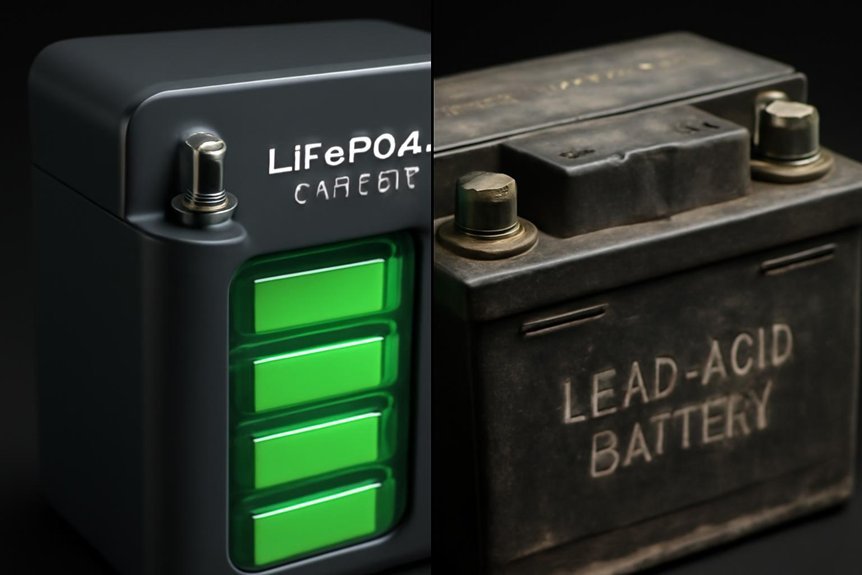
Although both LiFePO4 and lead acid batteries serve as energy storage solutions, their internal compositions and structural designs differ considerably. LiFePO4 batteries feature a cathode composed of lithium iron phosphate, providing enhanced thermal stability and chemical robustness. In contrast, lead acid batteries rely on lead dioxide as the cathode and sponge lead as the anode, immersed in sulfuric acid electrolyte. These composition differences directly influence their design features; LiFePO4 cells are constructed with lightweight, sealed units that minimize maintenance and improve safety. Lead acid batteries, on the other hand, contain liquid electrolytes requiring ventilation and regular maintenance. Overall, the distinct material choices and structural arrangements result in divergent performance characteristics, durability, and safety profiles, shaping their suitability for various applications.
Which Battery Type Offers Better Performance and Power Output?
When comparing performance, LiFePO4 batteries generally offer higher energy density and more consistent power delivery than lead acid cells. They also tend to have longer lifespans and better durability under repeated charge cycles. Analyzing these factors helps determine which battery type provides superior power output for demanding applications.
Energy Density Differences
Energy density is a critical factor in evaluating battery performance, as it determines how much energy a battery can store relative to its size and weight. Lifepo4 batteries typically have a lower energy density compared to lead acid batteries, meaning they store less energy per unit volume or weight. This impacts performance metrics such as runtime and overall efficiency, especially in space-constrained applications. While lead acid batteries often appear advantageous regarding initial capacity, Lifepo4 batteries excel in longevity and safety, compensating for their lower energy density. For applications requiring maximum energy storage in limited space, lead acid batteries may be preferred. However, for long-term performance and lightweight design, Lifepo4 batteries demonstrate superior performance metrics, balancing energy density with durability.
Power Delivery Capabilities
Power delivery capabilities are fundamental in determining how well a battery can support high-current demands, which are common in many applications such as power tools, electric vehicles, and backup systems. Lifepo4 batteries typically excel in power efficiency, providing high discharge rates without significant voltage drops, which guarantees stable power output during demanding tasks. Their voltage stability under load maintains consistent performance, reducing fluctuations that could impair device operation. In contrast, lead acid batteries often struggle with voltage sag under high loads, limiting their effective power delivery. This difference means Lifepo4 batteries can sustain higher current draws more efficiently, making them better suited for applications requiring reliable, high-power output. Overall, Lifepo4 batteries demonstrate superior power delivery capabilities through enhanced power efficiency and voltage stability.
Longevity and Durability
Although both Lifepo4 and lead acid batteries have established reputations for durability, Lifepo4 batteries generally outperform lead acid in longevity and overall performance. Lifepo4 cells typically endure 2,000 to 3,000 charge cycles, considerably higher than lead acid’s 500 to 1,000 cycles, reducing the frequency of battery maintenance and replacement. This extended lifespan translates into better long-term value and reliability. Additionally, Lifepo4 batteries maintain stable performance under diverse environmental conditions, making them more resilient over time. From an environmental impact perspective, Lifepo4 batteries produce fewer harmful emissions during manufacturing and disposal, further enhancing their durability and sustainability profile. Overall, Lifepo4 batteries demonstrate superior durability, reduced maintenance needs, and a smaller environmental footprint compared to lead acid counterparts.
How Long Do LiFePO4 and Lead Acid Batteries Typically Last?
Understanding the typical lifespan of LiFePO4 and lead acid batteries requires examining their durability and the factors that influence it. We analyze how cycle life, maintenance, and operating conditions impact their longevity. This comparison reveals critical insights into their long-term performance and suitability for various applications.
Battery Life Span Comparison
LiFePO4 batteries generally outperform lead acid batteries regarding longevity, owing to their more robust chemical stability and deeper cycle capabilities. Typically, LiFePO4 batteries last between 2,000 to 5,000 charge cycles, translating to 8-10 years of reliable use, depending on battery maintenance. In contrast, lead acid batteries usually endure around 500 to 1,000 cycles, or roughly 3-5 years. The key difference lies in their ability to sustain capacity over repeated charging cycles without significant degradation. Proper management of charging cycles and avoiding deep discharges extend lifespan. Factors such as temperature control and consistent maintenance further influence longevity. Ultimately, LiFePO4 batteries’ durability makes them a more cost-effective choice over the long term.
- Higher cycle count capacity
- Better resistance to capacity fade
- Reduced maintenance needs
- Longer service life
Factors Affecting Durability
The durability of LiFePO4 and lead acid batteries depends on a combination of operational and environmental factors that influence their chemical stability and cycle life. Temperature effects play a critical role, as high temperatures accelerate capacity loss and degrade internal components, while cold conditions reduce efficiency. Charge cycles also greatly impact lifespan; LiFePO4 batteries typically endure more cycles due to their stable chemistry, whereas lead acid batteries experience quicker capacity fade after repeated cycling. Proper management of charge and discharge rates is essential to optimize longevity. Additionally, deep discharges or overcharging can shorten both battery types’ lifespan, but LiFePO4 batteries are more resilient in this regard. Overall, environmental control and proper usage are crucial to maximizing durability for both chemistries.
Are LiFePO4 Batteries Safer and More Reliable Than Lead Acid?
Are LiFePO4 batteries genuinely safer and more reliable than lead acid counterparts? Yes, they typically outperform in safety features and reliability metrics. LiFePO4 chemistry inherently stabilizes thermal runaway risks, reducing fire hazards. Their robust internal architecture enhances cycle life and minimizes failure rates. Key safety features include built-in management systems that prevent overcharging and deep discharging. Reliability metrics demonstrate more consistent performance over time, with fewer maintenance requirements and longer service life.
- Enhanced thermal stability reduces fire risk
- Advanced battery management systems guarantee safe operation
- Longer cycle life improves overall reliability
- Lower maintenance needs contribute to dependable performance
What Are the Cost Differences Between LiFePO4 and Lead Acid Batteries?
While LiFePO4 batteries offer notable safety and longevity advantages over lead acid options, their initial purchase price is generally higher. The cost comparison reveals that LiFePO4 batteries typically cost 2-3 times more upfront. However, their longer lifespan and better performance can offset this over time. Price trends indicate that LiFePO4 prices are gradually decreasing due to manufacturing advancements, making them more accessible. Consider the emotional impact of the table below, illustrating immediate costs versus long-term savings:
| Battery Type | Initial Cost | Lifecycle Cost |
|---|---|---|
| Lead Acid | Lower | Higher (shorter lifespan) |
| LiFePO4 | Higher | Lower (longer lifespan) |
| Break-even | 2-3 years | Cost-effective over time |
Which Battery Is More Suitable for Different Applications and Use Cases?
Considering different applications and use cases, selecting the most suitable battery type requires analyzing specific performance requirements and operational conditions. Lifepo4 batteries excel in high-demand environments like solar applications, marine uses, and electric vehicles due to their high energy density and longevity. They’re also well-suited for backup power and off-grid systems, offering reliable, deep-cycle performance. Conversely, lead acid batteries are often preferred for less demanding roles such as power tools or stationary backup systems where initial cost is essential. For portable devices and renewable energy setups, Lifepo4’s lightweight design and fast charging provide advantages. Marine and electric vehicle applications benefit from Lifepo4’s stability and cycle life, whereas lead acid remains a cost-effective choice for simpler, static uses.
What Factors Should You Consider When Choosing Between LiFePO4 and Lead Acid Batteries?
Choosing between LiFePO4 and lead acid batteries requires a careful assessment of several critical factors. Key considerations include battery maintenance, environmental impact, cost, and lifespan. LiFePO4 batteries generally demand less maintenance and offer longer cycle life, reducing long-term costs. Their environmental footprint is smaller due to safer materials and recyclability. Conversely, lead acid batteries are more affordable upfront but require regular maintenance and have a shorter lifespan. To visualize the differences:
| Factor | LiFePO4 | Lead Acid |
|---|---|---|
| Maintenance | Low | High |
| Environmental Impact | Lower | Higher |
| Cost | Higher initial, lower long-term | Lower initial, higher total |
| Lifespan | Longer | Shorter |
These distinctions help us weigh the trade-offs in application-specific contexts.
Frequently Asked Questions
Can Lifepo4 Batteries Be Recycled More Easily Than Lead Acid Batteries?
We find LiFePO4 batteries are generally easier to recycle due to simpler recycling methods and fewer hazardous materials, which also contribute to their longer battery lifespan, making them more sustainable compared to lead acid batteries.
How Do Temperature Variations Affect Each Battery Type’s Performance?
Temperature variations impact both batteries’ performance efficiency, but LiFePO4 offers superior temperature stability, maintaining consistent performance in extremes. Lead acid’s efficiency drops considerably in high or low temperatures, affecting longevity and reliability.
Are There Environmental Concerns Associated With Disposing of Lifepo4 Batteries?
We find that disposal methods for LiFePO4 batteries minimize environmental impact through recycling programs, reducing hazardous waste. Proper recycling is essential, as it prevents potential environmental contamination and guarantees valuable materials are recovered efficiently.
Do Lifepo4 Batteries Require Special Charging Equipment?
Like steering a ship, we find Lifepo4 batteries do require specialized charging techniques and proper battery management. This guarantees safety, longevity, and peak performance, making them more technically demanding but ultimately more reliable than traditional lead-acid options.
What Are the Warranty and Maintenance Differences Between These Batteries?
We find LiFePO4 batteries offer longer warranty durations, typically around 10 years, with lower maintenance frequency due to fewer components and less corrosion risk, unlike lead acid batteries that require regular checks and shorter warranty periods.
Conclusion
In conclusion, choosing between LiFePO4 and lead acid batteries is like selecting the right tool for a precise task. LiFePO4 batteries, with their longer lifespan, higher safety, and better performance, often outperform lead acid options for demanding applications. However, initial costs and specific use cases matter. We recommend weighing performance, safety, and budget considerations carefully—making an informed choice that aligns with your needs guarantees maximum efficiency and reliability over time.