DCHOUSE 12V 100Ah Battery: Product Overview
A battery that can stop charging before freezing temperatures damage its cells is a useful proposition for winter RV trips, boats, and ice-fishing equipment. The DCHOUSE 12V 100Ah battery combines a Group LiFePO4 design with built-in Bluetooth monitoring and temperature-based protection, making it more informative than a basic drop-in battery. We think it is worth considering for buyers who want phone-based diagnostics, but the missing dimensions, weight, current limits, and live price prevent us from calling it an automatic bargain.
The listing specifies a 12V output, 100Ah capacity, Group format, integrated Bluetooth, and a claimed service life of up to years or 15,000 cycles. DCHOUSE presents it for RVs, boats, trolling motors, fish finders, ice-fishing equipment, camping systems, solar storage, and home alarm systems. Those applications cover both mobile and standby power, although the correct fit still depends on the rest of the system.

Key Specifications and Real-World Fit
The 100Ah rating describes the battery’s stated storage capacity, but it does not by itself tell us how long a particular appliance will run. Runtime depends on the appliance’s wattage, inverter losses where applicable, charging habits, temperature, battery-management cutoffs, and the amount of capacity the system permits you to use. We would calculate expected daily watt-hours before choosing any battery for an RV or solar installation.
Group is a familiar battery format in marine, recreational-vehicle, and off-grid applications, so the designation may make this model a plausible replacement candidate for some existing compartments. However, the listing does not provide the physical dimensions, weight, terminal type, maximum charging current, maximum discharge current, or confirmed inverter compatibility. Those omissions matter more than the label alone: a nominally suitable battery can still fail to fit, connect, or support a demanding load.
LiFePO4 chemistry is generally attractive for repeated cycling because it is designed for rechargeable use and avoids several practical drawbacks associated with conventional lead-acid banks, including heavier construction and reduced cycle longevity. DCHOUSE claims up to 15,000 cycles, compared with the stated 200–500 cycles for typical SLA, AGM, or lead-acid batteries. That is a manufacturer claim, not an independently verified endurance result, and actual life will depend on charge settings, temperature, depth of discharge, and current.
The description also says the battery has passed UL and UN38.3 testing certification. Before installation, we would request or locate the exact documentation and confirm that it applies to this precise battery configuration, particularly if the battery is being fitted in a boat, vehicle, or permanently installed solar system.
Low-Temperature Protection on the DCHOUSE 12V 100Ah Battery
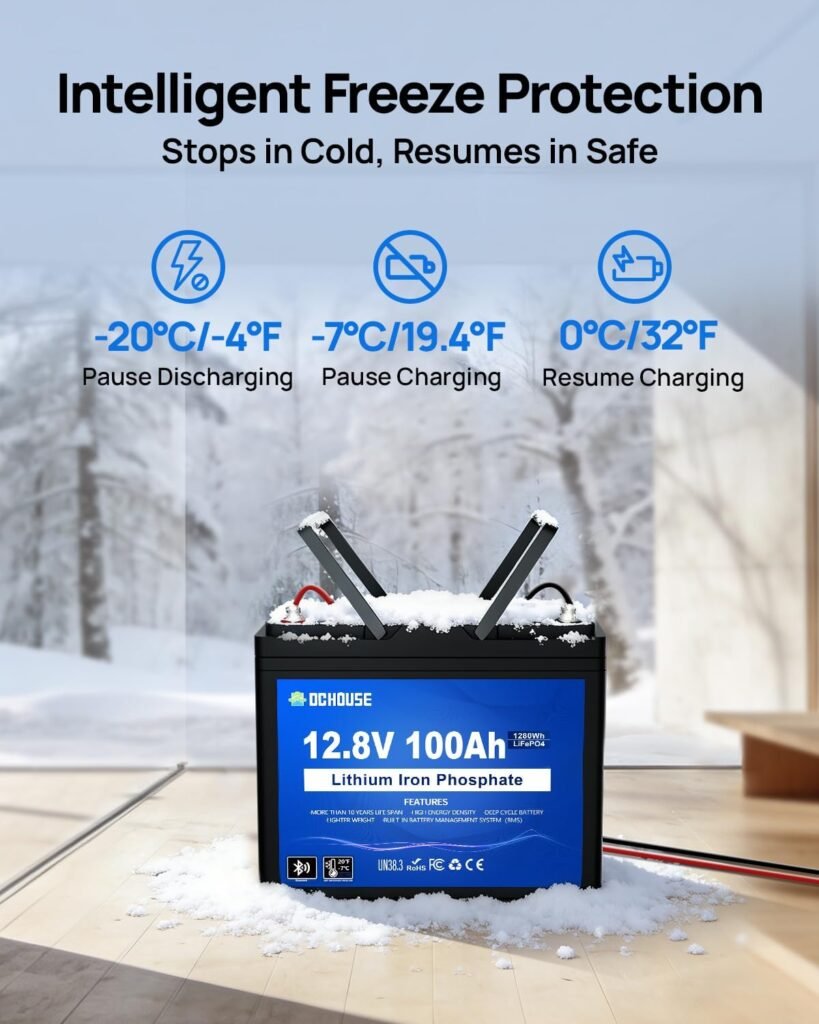
The cold-weather system is one of the model’s clearest selling points. According to the listing, the battery-management system stops charging when the temperature sensor detects less than 32°F, stops discharge below -7.6°F, and is said to recover automatically after the temperature rises to 0°F.
That distinction between charging and discharge matters. Charging LiFePO4 cells below freezing can cause damaging lithium plating, so a charging cutoff can prevent a charger from pushing current into cells that are too cold. Discharge protection serves a different purpose: it stops connected equipment from drawing power once the battery reaches the lower discharge threshold. A battery can therefore refuse a charge while still being able to power equipment, depending on its measured temperature.
For winter camping, marine storage, and ice-fishing setups, we would install the battery where its sensor reflects the battery’s actual temperature rather than a warmer surrounding compartment. We would also use a charger designed for lithium batteries and treat the protection circuit as a safeguard, not as a heater. If the battery remains frozen for an extended period, it may still be unavailable even though the cutoff prevents one form of damage.
The stated thresholds have an unusual relationship: charging protection begins at freezing, discharge protection is much lower, and automatic recovery is listed at 0°F, which is below the charging cutoff. We would check the manual for the exact recovery logic before relying on this unit in sub-freezing conditions. That clarification should be considered essential for an unattended winter installation.
Bluetooth App Monitoring and Battery Management
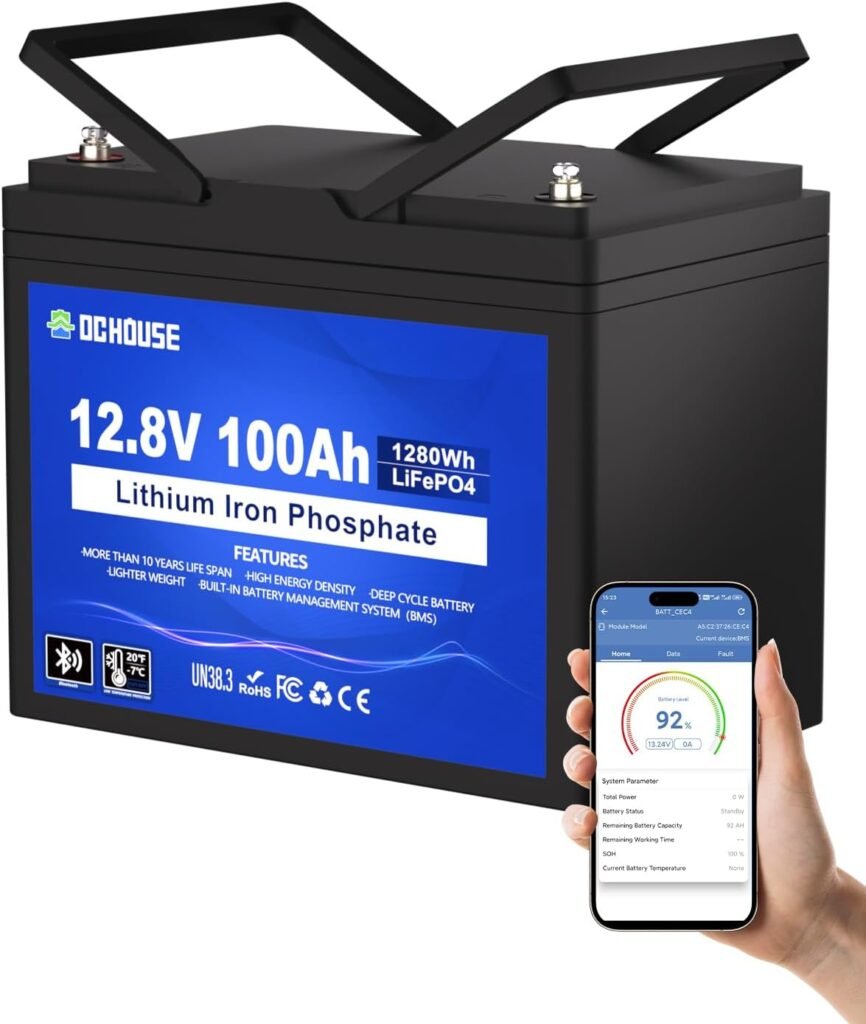
The built-in Bluetooth connection lets us check the battery without opening an RV compartment, climbing into a boat’s storage area, or approaching a solar cabinet with a handheld meter. DCHOUSE states that the signal range is 5–10 metres, which should be useful for nearby checks but should not be treated as remote monitoring across a campsite or property.
The advertised DCHOUSE app displays state of charge, voltage, current, and cell-level information, with a dedicated fault page. Cell-level readings can be more informative than a single voltage figure because they may help reveal imbalance, charging trouble, excessive load, or a protection event. A fault page could also shorten troubleshooting time, provided the readings are accurate and the app remains connected when the battery enters a low-power protection state.
Our suggested setup process is straightforward:
- Install the DCHOUSE app on a compatible phone and enable Bluetooth.
- Stand within the stated signal range and pair with the battery.
- Record the initial state-of-charge and voltage readings after installation.
- Check the displayed values again after charging and while a known load is operating.
The listing does not confirm phone operating-system compatibility, simultaneous connections, historical graphs, firmware updates, password security, or monitoring behaviour during protection mode. Customer reviews indicate that app pairing and reading accuracy should be judged from repeated reports rather than from the presence of Bluetooth alone. The feature is useful, but it is not a substitute for correctly sized cables, fuses, chargers, or a physical inspection.

Charging, Connections, and Installation Limits
DCHOUSE specifically instructs owners to use a dedicated lithium battery charger, not a charger designed only for conventional lead-acid batteries. That instruction should be followed even if an existing charger appears to have the correct nominal output, because charging profiles and voltage behaviour can differ between chemistries.
The listing permits no more than four batteries connected in series or parallel. Series wiring raises the bank voltage, while parallel wiring increases capacity; the resulting performance still depends on the approved battery-management limits, wiring, fusing, and load requirements. We would not assume that four units automatically suit a large inverter, trolling motor, or unattended solar system without the manufacturer’s wiring guidance.
Before installation, we would work through this sequence:
- Confirm compartment clearance, terminal orientation, and the physical measurements in the manual.
- Inspect the shipment for case, terminal, or packaging damage.
- Verify the charger’s lithium profile and confirm the required cable and fuse sizes.
- Install appropriate overcurrent protection close to the battery.
- Pair the app and record baseline readings before connecting the complete load.
We would also check terminal torque, approved wiring layouts, cable gauge, charging voltage, and whether batteries must be matched by age and state of charge. Different chemistries, capacities, ages, or brands should not be mixed in one bank unless DCHOUSE expressly approves the arrangement. The supplied description leaves peak current, low-voltage cutoff, operating temperature range, ingress protection, and the warranty procedure unconfirmed, so those are buying questions rather than details we should guess.
What Customers Are Saying About the DCHOUSE 12V 100Ah Battery
The supplied product information does not include an Amazon star rating, review count, or individual verified-buyer comments. We therefore cannot honestly report that buyers praise the runtime, complain about charging speed, or confirm dependable winter operation. Any review that assigns a numerical rating or describes a broad customer consensus from this data would be inventing evidence.
When feedback is available on the product page, we would separate it into practical categories: app pairing, accuracy of state-of-charge readings, cold-weather cutoffs, capacity under load, shipping condition, terminal quality, and seller responsiveness. Verified buyers report useful information only when they explain the system they used, the charger settings, the load, the climate, and the length of testing.
We would look for repeated patterns rather than isolated incidents. Multiple owners confirming the stated Bluetooth range, consistent readings against a separate meter, and predictable low-temperature behaviour would be more persuasive than a single enthusiastic comment. For RV and marine shoppers, especially valuable reviews would describe real-world runtime, trolling-motor performance, solar charging, winter storage, and compatibility with common lithium chargers.
DCHOUSE states that it provides three years of reported service for each battery and directs customers to contact the seller through Amazon or the after-sales address in the manual. We would treat that as a service commitment, not automatically as a clearly documented replacement warranty. Because battery revisions, app versions, packaging, and seller support can change, we recommend checking the newest reviews available before placing an order.
Who Should Consider This Battery?
The strongest candidates are RV owners replacing a lead-acid bank, boat owners needing a compact 12V house battery, campers storing energy from solar panels, and users who want to check status from a nearby phone. Bluetooth is particularly helpful when the battery is installed inside a compartment that is awkward to open repeatedly.
Cold-climate users may also appreciate the charging cutoff because it addresses a known LiFePO4 risk. Protection does not create heat, guarantee available power during prolonged freezing, or remove the need for suitable winter storage. Anyone depending on the battery in severe weather should plan for the actual environmental conditions rather than assuming the BMS will solve them.
We would research further before using this model with a high-draw trolling motor, large inverter, four-battery bank, unattended solar installation, or a compartment with restricted clearance or ventilation. The missing current and physical specifications make those use cases impossible to approve from the listing alone.
Our decision process would be:
- Confirm the physical fit and terminal arrangement from the manual.
- Calculate expected daily watt-hours and identify the largest peak load.
- Verify charger settings and required protective hardware.
- Check winter temperatures and whether external heating or insulation is needed.
- Compare documented support terms and current prices with alternatives.
On the evidence supplied, we would recommend conditional consideration rather than a blanket recommendation. The monitoring and protection features are relevant, but system compatibility must come first.
Pros and Cons
Pros
- Built-in Bluetooth app monitoring with advertised state-of-charge, voltage, current, cell-level, and fault information
- Explicit low-temperature charging and discharge protection for winter-oriented installations
- Group LiFePO4 format suited to a range of stated RV, marine, camping, solar, and standby applications
- Manufacturer claims up to 15,000 cycles and a service life of up to years
- Stated three-year service commitment
Cons
- The supplied listing does not confirm dimensions, weight, terminal type, charging current, discharge current, or inverter compatibility
- No star rating, review count, or individual customer comments were provided for independent sentiment analysis
- The stated temperature recovery behaviour is unusual and needs manual verification
- A dedicated lithium charger is required, which may add to the system cost
Final Verdict
Key Takeaways
- Bluetooth monitoring and cell-level fault information give this battery more diagnostic capability than a basic drop-in unit.
- The stated temperature cutoffs are useful for cold-weather planning, but the unusual recovery description should be checked in the manual.
- The listing does not confirm dimensions, weight, current limits, terminal details, or inverter compatibility.
- The advertised 15,000-cycle life and three-year service commitment are promising but require documentation and real-world review evidence.
- This is a conditional choice: verify fit, charger settings, electrical limits, support terms, and live price first.
Frequently Asked Questions
Does this battery include Bluetooth monitoring?
Yes. The listing says Bluetooth is built in and that the DCHOUSE app can display state of charge, voltage, current, cell-level information, and faults. Compatibility details for specific phones are not provided.
Can it be charged below freezing?
The product description says charging is cut off when the temperature sensor detects below 32°F. We would still use a lithium-compatible charger and check the manual for the exact recovery behaviour in cold conditions.
How many batteries can be connected together?
The manufacturer states that no more than four batteries should be connected in series or parallel. Approved wiring, fusing, cable sizing, and load limits should be confirmed before building a bank.