ECO-WORTHY 12V 100Ah LiFePO4 Battery: Product Overview
Replacing a heavy lead-acid battery can free up useful payload in a motorhome, boat, cabin or off-grid installation, but the replacement needs to fit the existing system rather than simply look attractive on paper. The ECO-WORTHY 12V 100Ah LiFePO4 battery is built around that practical upgrade: it combines a 1.28kWh nominal capacity with Bluetooth 5.1 monitoring and a low-temperature charging cutoff.
Its headline capacity is only the starting point. Usable energy depends on the permitted depth of discharge, charging efficiency, inverter losses and the loads connected to it. A refrigerator, kettle, heater or power tool can draw energy far faster than a phone charger or LED lighting, so we would assess the complete power budget before treating 1.28kWh as an overnight guarantee.
Our review therefore focuses on the battery’s physical fit, monitoring functions, winter charging safety, protection circuitry, installation compatibility, expansion potential and alternatives available through Amazon. The feature combination is promising for the right system, but it isn’t automatically a complete power solution.

Key Specifications and Installation Fit
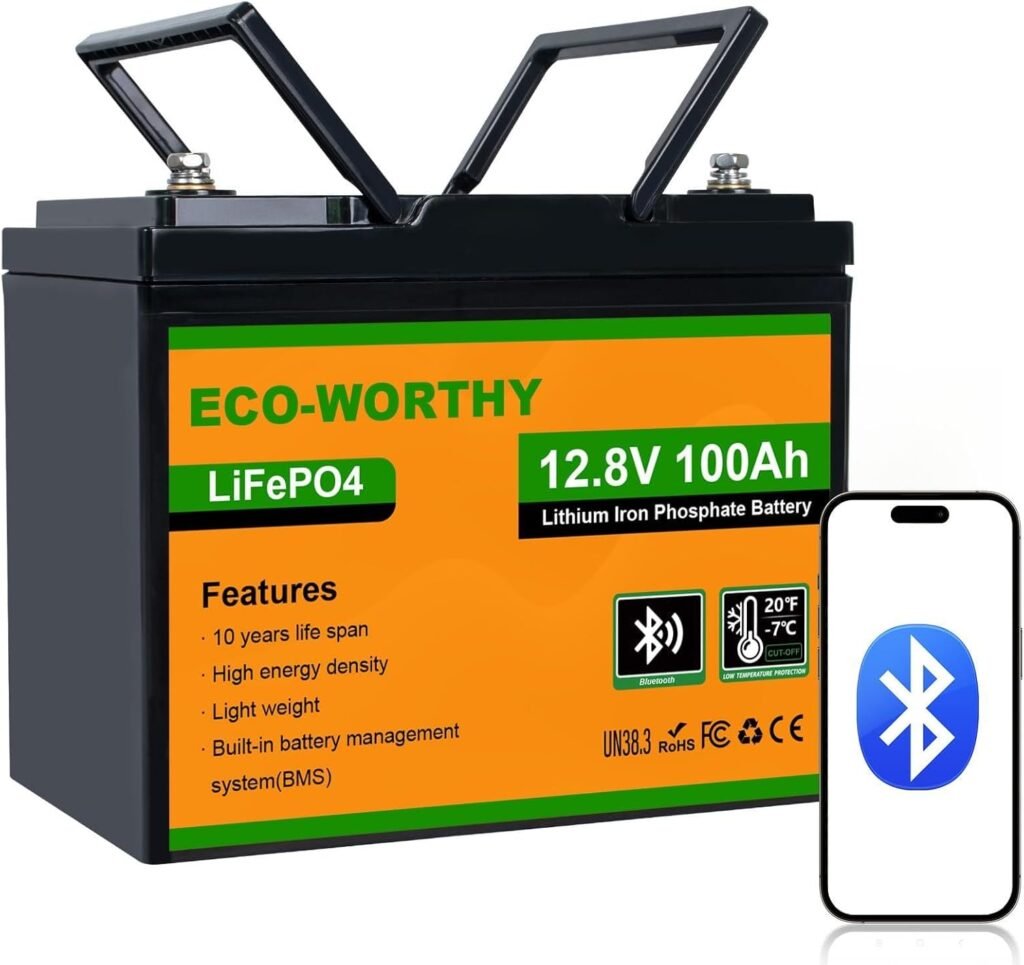
The ECO-WORTHY battery uses a BCI Group format, measuring 10.23 inches long, 6.6 inches wide and 8.23 inches high. The stated weight is 23.15 pounds. Those figures make it relevant to RV owners looking for a direct-sized replacement, although “fits Group 24” should never be treated as proof that every compartment is interchangeable.
Before ordering, we would work through this short installation check:
- Measure the tray’s length, width and usable height, including the clearance needed above the case.
- Compare the terminal position with the existing cables and confirm that the leads will reach without being stretched or sharply bent.
- Check the hold-down arrangement, terminal hardware and access for a fuse or disconnect.
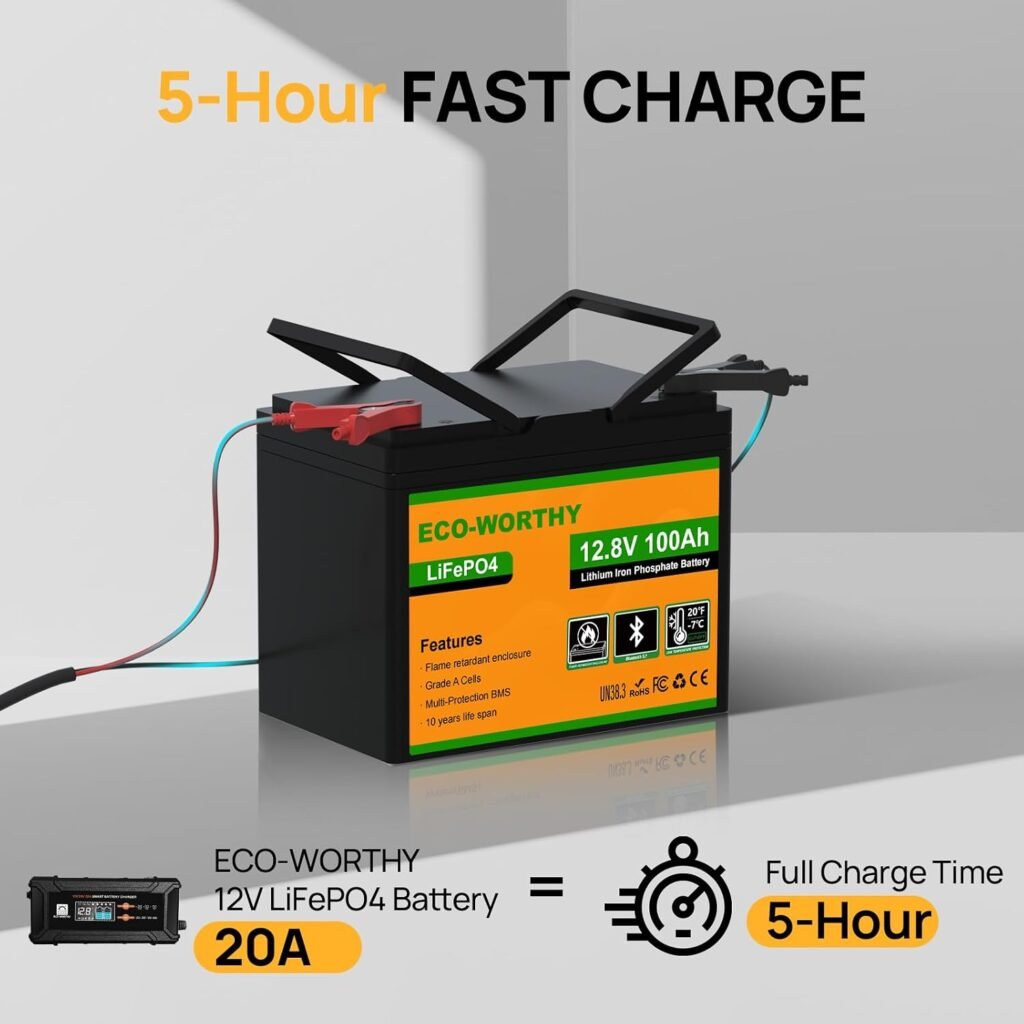
- Confirm that the charger, solar controller and inverter support a lithium battery profile and the required voltage.
- Size the fuse and cables for the actual continuous and surge current, not just the battery’s nominal capacity.
The stated 23.15-pound weight is roughly half that of a similarly sized lead-acid battery, according to the product description. That can reduce payload and make handling easier, while also changing weight distribution in a vehicle or boat. The battery is classified as 12V, but its actual voltage will vary during charging, discharge and Bluetooth reporting; a nominal label is not a fixed meter reading.
We would also treat this unit as a battery or building block, not a complete energy system. Solar panels, a lithium-compatible charger, inverter, protective fuse, disconnect and suitable wiring remain separate design decisions.
12V 100Ah LiFePO4 Battery Features in Detail
LiFePO4 chemistry is generally chosen over lead-acid when lower weight, reduced routine maintenance and more usable discharge are priorities. It is well suited to repeated charge-and-discharge use in camping, RV and solar systems, but the supplied information does not provide a guaranteed cycle-life figure. We would not use an unsupported cycle count to calculate payback or promise a particular service life.
The integrated BMS is rated at 100A and is listed as protecting against overcharge, over-discharge, over-current above 100A, short circuit and abnormal temperature conditions. That protection is valuable, but a 100A rating does not mean every inverter, motor or trolling-motor startup will work. We would compare the intended appliance’s continuous draw and surge demand with the battery’s published limits, then allow for startup events and cable losses.
The stated operating range is -20°C to 55°C. This should be read separately from charging permission: general operating or discharge limits do not automatically mean the battery may be charged at every temperature within that range. The product description also refers to automotive-grade cells and CE, RoHS and IEC references. Those are stated certification or compliance claims; we would inspect the current listing documents to identify the exact standards, test scope and covered configuration.
A layered BMS and quality cells may support stable operation, yet neither can compensate for reversed polarity, an incorrectly wired bank, inadequate fusing, water ingress or an unsuitable charger. Correct system design still matters more than a label on the case.
Bluetooth 5.1 Monitoring: What the App Can Show
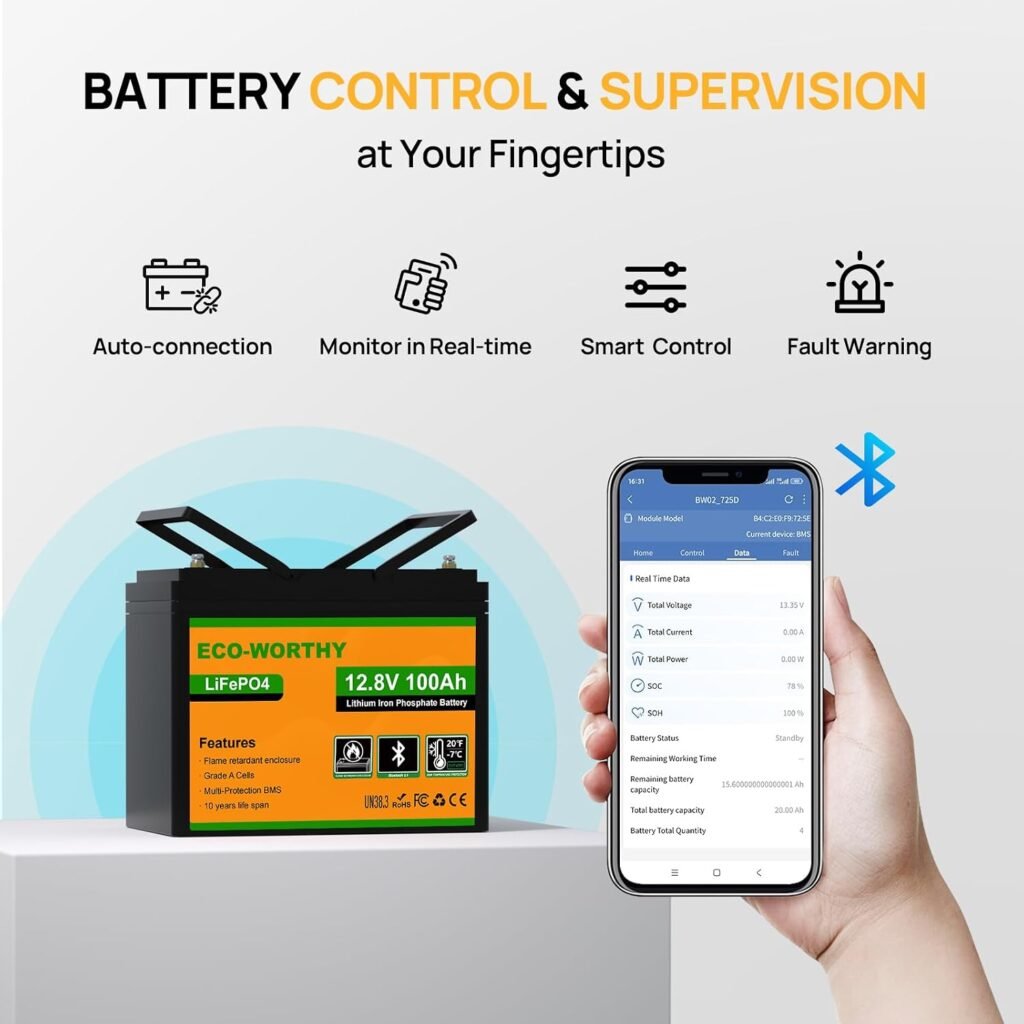
The advertised Bluetooth 5.1 connection is intended to show real-time voltage, current, state of charge, state of health and remaining capacity on a smartphone. That can be more useful than checking a simple voltage display, particularly when the battery is installed inside an RV compartment or a cabin cabinet.
For example, we could check the charge level before leaving a campsite, observe whether a solar controller is actually delivering current, or spot an unexpected overnight drain. In a bank of several batteries, separate app readings may also help identify one unit behaving differently from the others instead of relying on a single combined voltage measurement.
We would keep expectations realistic. The supplied data does not specify Bluetooth range, supported phone versions, refresh speed, app update policy or how well the signal works through a closed metal compartment. Customer comments about pairing, inaccurate state-of-charge estimates or unclear warnings should be checked on the current listing before purchase.
Our setup sequence would be:
- Install the official application and enable Bluetooth on the phone.
- Identify the correct battery rather than assuming the first displayed device is yours.
- Record baseline readings at rest.
- Test the display while charging and again under a known load.
- Compare the app with a correctly installed meter if the readings affect a safety-critical decision.
App figures are diagnostic aids, not laboratory measurements. Fuses, disconnects, low-voltage protection and properly installed meters remain necessary for a dependable system.

Low-Temperature Charging Protection for Winter Use
The battery’s most distinctive safety feature is its stated -7°C charging cutoff, equivalent to 19.4°F. Charging LiFePO4 cells below a safe temperature can cause permanent internal damage, so a BMS that halts charging when the cell temperature is too low is useful for motorhomes, boats, cabins and outdoor solar systems.
The cutoff is not a heater. It should stop charging during cold conditions, but it does not warm the battery, guarantee uninterrupted power in every winter environment or make an exposed installation suitable for severe weather. Once the cells warm, the charger should resume correctly; we would test that behaviour before relying on the system away from home.
The separate operating range of -20°C to 55°C must not be confused with charging permission. A battery may be able to discharge or operate at a lower temperature than it can safely accept a charge. We would install it away from direct weather exposure, protect the compartment from condensation and avoid bypassing the BMS cutoff.
Because no review rating, review count or individual customer comments were supplied with the product data, we cannot honestly claim that buyers have reported successful recovery, nuisance cutoffs or confusing app warnings. Before purchasing, we would search recent reviews for those exact conditions, especially comments from users in unheated RV compartments or winter solar installations.
Series and Parallel Expansion Options
ECO-WORTHY states that the battery supports 4P2S and 2P4S arrangements, with a system range from 1.28kWh to a maximum of 10.24kWh. In practical terms, correctly configured series connections can support a 24V or 48V system, while parallel connections increase capacity at the same system voltage. The arrangement must follow the manufacturer’s instructions rather than being improvised from the labels alone.
Four 100Ah units can create a larger bank, and eight units can reach the advertised 10.24kWh nominal maximum, but each additional battery adds cabling, fusing, balancing and fault-isolation work. Batteries in a bank should be the same model, age, state of charge and general condition. Equal cable lengths and appropriate over-current protection help the units share current more predictably.
Bluetooth can make troubleshooting a larger bank less frustrating. If one unit reports an unusual state of charge or health reading, we may be able to isolate it more quickly than by examining total bank voltage alone. That does not mean the app can correct poor cable routing, a loose connection or an incorrectly configured series-parallel layout.
We would plan an expansion in this order:
- Define whether the system will run at 12V, 24V or 48V.
- Calculate daily energy use and the desired reserve.
- Estimate continuous and peak current.
- Select the number of batteries and confirm charger and inverter compatibility.
- Install suitable fuses, disconnects and cables according to competent electrical practice.
What Customers Are Saying
The supplied product information does not include a displayed star rating, review count or individual customer review text. Consequently, we cannot responsibly write that buyers praise the battery’s life, report a particular app failure rate or confirm stable winter performance. Any review that supplied those figures without a source would be inventing evidence.
We would use the current review record to look for repeated themes rather than relying on one-line impressions. Useful positive signals would include straightforward replacement installation, lower carrying weight, reliable Bluetooth visibility, steady performance under a stated RV or solar load and clear behaviour when the temperature cutoff activates.
We would also look for recurring complaints about app pairing, state-of-charge accuracy, unexpected BMS shutdowns, terminal hardware, charger compatibility, delivery condition or support responsiveness. A comment becomes more useful when it identifies the inverter, charger, load, ambient temperature, installation date and measured voltage or capacity. An isolated anecdote is much weaker than several detailed reports describing the same issue.
Before buying, we would check:
- Recent verified-purchase reviews, especially those containing photographs.
- Long-term reports rather than comments written immediately after delivery.
- The seller’s return window and the stated warranty terms.
- Current app reviews and phone compatibility information.
- Comments from buyers using the same charger, inverter or RV battery compartment.
Until those details are available, our confidence should come from the published specifications rather than from an assumed customer consensus.
Who Should Buy This Battery?
This model looks most suitable for an owner replacing a compatible Group battery in a motorhome, a camper user who wants lighter onboard storage, a marine buyer with a compatible trolling-motor demand, or a cabin owner building a modest off-grid system. Bluetooth is especially useful when the battery is hidden away and the user wants charge and health information without fitting a separate display.
The cold-charge cutoff also makes sense for seasonal vehicles and installations that may encounter freezing conditions. People living in very cold climates should still plan a protected location, insulation or battery heating if their system requires charging during prolonged low temperatures. The cutoff prevents one type of damage; it does not supply warmth or guarantee power availability.
We would pause if we needed substantially higher continuous current, an integrated heater, a different case footprint, a guaranteed cycle-life number or a complete battery-and-charger kit. Nominal storage of 1.28kWh may handle modest lighting, electronics and communications, but high-draw appliances consume it quickly, especially after inverter losses are included.
Our three-question fit test is simple:
- Does the battery physically fit the intended compartment and connect safely?
- Can the charging equipment use the correct lithium charging profile?
- Does the BMS rating accommodate the intended continuous and surge loads?
If any answer is uncertain, we would resolve that issue before ordering rather than relying on the product title.
Pros and Cons
Pros
- Bluetooth 5.1 monitoring for voltage, current, state of charge, state of health and remaining capacity
- Stated -7°C low-temperature charging cutoff for added winter charging protection
- BCI Group format and claimed 23.15-pound weight for easier replacement handling
- 100A BMS with listed overcharge, over-discharge, over-current, short-circuit and temperature protections
- Advertised 4P2S and 2P4S expansion support up to 10.24kWh nominal capacity
Cons
- The supplied £0.00 price is placeholder information, so value cannot be judged without checking the live listing
- No cycle-life figure, review rating, review count or detailed customer feedback was supplied
- The cold-weather feature stops charging but does not heat the battery
- A 100A BMS may not suit every high-surge inverter, motor or trolling-motor application
- Charger compatibility, warranty coverage, app performance and certification scope require verification
Final Verdict
Key Takeaways
- The ECO-WORTHY battery combines Bluetooth 5.1 monitoring, a 100A BMS and a stated -7°C charging cutoff in a Group replacement format.
- Its 1.28kWh nominal capacity suits modest RV, marine, cabin and off-grid loads, but inverter losses and high-draw appliances must be included in planning.
- The published -20°C to 55°C operating range is separate from the low-temperature charging cutoff; the cutoff does not heat the battery.
- No review rating, review count or customer comments were supplied, so current buyer feedback should be checked before purchase.
- The listed £0.00 price is incomplete data. Confirm live pricing, warranty, compatibility and total installation cost.
Frequently Asked Questions
Does the ECO-WORTHY battery include Bluetooth monitoring?
Yes. The product description advertises Bluetooth 5.1 monitoring through a smartphone app, including voltage, current, state of charge, state of health and remaining capacity. We would still use correctly installed protective equipment and an independent meter for critical checks.
Can it be charged below -7°C?
The stated low-temperature protection is designed to stop charging below -7°C, or 19.4°F. It does not heat the cells, so the battery should be installed in a protected location and allowed to warm before charging resumes.
Is this battery suitable for every Group compartment?
Not automatically. The Group description helps identify the intended format, but terminal position, hold-down hardware, cable reach and clearance must match the particular vehicle or installation.
Can several ECO-WORTHY batteries be connected together?
The product description states support for 4P2S and 2P4S configurations and a nominal expansion range up to 10.24kWh. Series-parallel banks should use matched batteries, equalised cabling, correct fusing and the manufacturer’s wiring instructions.